Long Distance Polyamory: Making Distance Work Across Several Relationships
The first thing long distance polyamory teaches you is that a calendar can be a love language. Two people who live forty minutes apart can make a Tuesday of it. Two people who live four hundred miles apart cannot. Every hour they spend together has to be argued for, paid for, and written down in advance. That scarcity is not a defect in the relationship. It is the material the relationship is made of.
Meanwhile the advice people get about distance is almost always a countdown. Survive until the move. Keep the spark alive. All of it treats the miles as a waiting room. Plenty of long distance polyamory has no end date at all, and a good deal of it should not want one. The question worth asking is not how to get through the distance. It is how to build a relationship that is real at this range, while you are living inside it.
Why Distance Changes the Clock
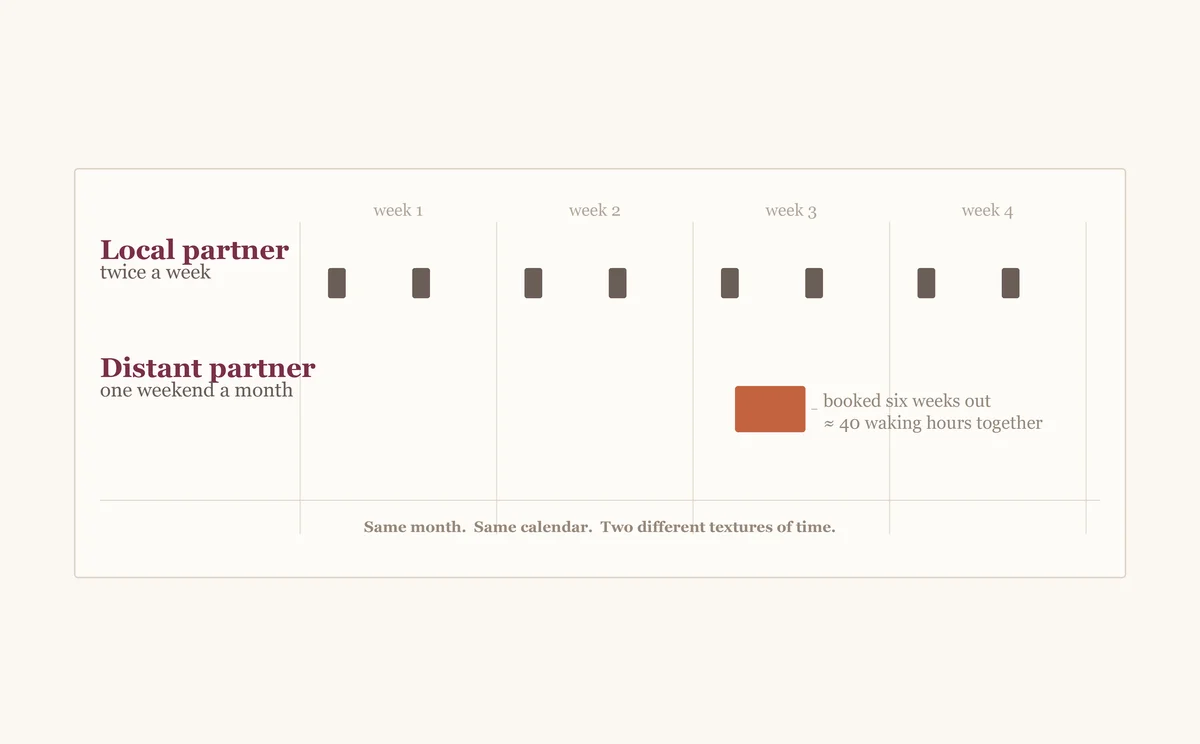
Three relationships, one of them three states away, is not the same as three relationships in one city. The distant one compresses. A weekend visit might give you forty waking hours together, which is more raw company than a couple living together often gets in two weeks. Yet none of it is ordinary, and ordinary is where people find out how they actually live.
Here is the arithmetic that trips people up. A partner who comes over twice a week and stays the night gets less total time than the partner who flies in for one long weekend a month. On a spreadsheet the distant partner looks indulged. In practice the forty hours arrive with a plan attached, because they cost a plane ticket. You cook something worth cooking. You go somewhere. Nothing is allowed to be dull.
That is why long distance polyamory rewards a different kind of planning. Local time can be improvised and still work. Distant time cannot be improvised at all, so it has to be protected, and protection is a skill most people learn the hard way.
What the Research Finds
The evidence on distance is more encouraging than the folklore, though it comes with a sharp edge. A diary study of dating couples found that partners living apart disclosed more, formed more idealized views of each other, and reported intimacy equal to or higher than couples who lived near each other. The 2013 study in the Journal of Communication traced the effect to the medium itself. Text and video reward deliberate personal disclosure, and deliberate personal disclosure reads as closeness.
However, the same paper recorded a detail that rarely makes the summary. Those distant couples also avoided conflict and taboo subjects more than local couples did. Given ninety minutes on a call and three weeks until the next one, almost nobody spends the time on the argument they have been dodging. They spend it on the good parts. The intimacy and the avoidance are one mechanism, not two, and long distance polyamory inherits both halves of it.
The Reunion Problem
Then there is the finding that should be printed on every moving van. A longitudinal study of couples living apart found that idealization was higher the less often partners saw each other face to face. Those couples were also more likely to break up after they closed the distance than while they were apart. Idealization during separation predicted instability after reunion. The authors published it in the Journal of Social and Personal Relationships, and the conclusion is brutal in its plainness: infrequent contact can hold a relationship together precisely as long as the distance lasts.
Read that in polyamory terms and it gets sharper. The partner you see once a month is the one you have never had a boring Tuesday with. You have never argued about dishes, never watched them be ill, never seen the version of them that is tired and out of clean shirts. You are in love with somebody you have only met in their best mood, and their best mood is genuine. It is just not the whole person.
This is the same engine that drives new relationship energy, running for months instead of weeks because every encounter is a highlight. It also explains why the date you move in, or the reunion after a long stretch apart, can feel like a setback rather than a climax. The person who arrives is not the person you were dating. They are real, and reality is less flattering than a video call.
The Asymmetry It Creates
Most people picture distance as a problem of longing. The harder version is a problem of arithmetic, and it shows up in the mixed configuration: one partner across the country, another ten minutes away. Each of them occupies a different category of your life, and neither category is obviously better.
The local partner gets the Tuesday. They get the grocery run, the bad day, the sofa, the plain middle of the week. What they do not get is ceremony. Nobody books a restaurant for a Wednesday in the same neighborhood, and so their relationship can start to feel like logistics with kissing attached. Meanwhile the distant partner gets the planned weekend, the airport pickup, the two days where somebody has clearly made an effort. What they do not get is any of the middle.
Both of them are lonely in opposite directions, and each believes the other has the better deal. The local one envies the romance. The distant one envies the ordinariness. In practice this is the part of long distance polyamory nobody warns you about, because the jealousy involved is not sexual and does not look like jealousy at all. It looks like a partner saying, quietly, that they are tired of being the one who is always leaving.
Who Travels in Long Distance Polyamory
Somebody does more of the traveling, and that somebody is keeping a tally whether or not they admit it. Flights, fuel, unpaid leave, the holiday allowance burned on a relationship that lives in another time zone. If the same person always makes the trip, the trips accumulate into a debt nobody has sent a bill for, and the shortfall eventually presents itself as resentment over something trivial.
There is a second distortion, too. The traveler is a guest in another person’s apartment. They cannot complain about the dishes, the temperature, or the fact that the apartment has no chair with a back. Guest status suppresses ordinary friction, and suppressed friction is not the same thing as compatibility. Meanwhile the person who stays home carries the empty weeks, which are invisible to the partner who is only ever there for the good forty hours.
So say the count out loud. Count the trips on both sides in money and in leave, at least once a year. Then decide whether the split should change. A number that both people have looked at is a very different object from a number that one person has been quietly resenting.
The Jealousy Distance Creates
The jealousy here is rarely about a partner’s other partner. It is about proximity itself. It is the specific ache of hearing that they had dinner with someone on a Tuesday, unplanned, because the evening was free and you were eight hundred miles away with nothing scheduled. Nobody did anything wrong. That is what makes it so hard to raise.
Standard jealousy advice does not fit, because it assumes the cure is reassurance, and reassurance is the wrong currency. You cannot reassure somebody out of the fact that you were at dinner. What actually helps is a routine, plus a share of the ordinary. A standing call that happens whether or not there is news carries more weight than any speech. So does a video call where you both cook and say almost nothing, or a running message thread about nothing in particular.
The tools people use for jealousy mostly work by shrinking the unknown. At a distance the unknown is enormous, so the tools have to run more often, not harder. And the partner doing the asking deserves an answer that is a schedule rather than a promise. That is what long distance polyamory asks for here: not more reassurance, but more visible structure.
Long Distance Polyamory Needs a Calendar
A standing appointment beats a weekly negotiation. Pick the slot, put it in both calendars as a recurring event, and treat it as a shift that cannot be swapped casually. This sounds clinical, and it is the single most reliable thing in the whole arrangement. A call that might happen is a call that gets shifted, and a call shifted three weeks running teaches both people something about their place in the other’s life.
Build one rule around cancellation while you are still calm. A scheduled hour comes before a preference nobody scheduled. An emergency outranks everything and is put back in the calendar within the week. Those two sentences together cover most of what will actually happen, and the scripts for hard conversations on this site will get you through the version where somebody cries.
Then protect some of it from being special. The visit where you do nothing is the visit that tells you whether you can live together. It is also the one that is hardest to justify when the ticket cost four hundred dollars, so justify it in advance. Sometimes the plan is a film, a takeout meal and an early night, and that counts as the relationship working rather than the relationship stalling.
Watch, as well, for the trap of local urgency. The partner in the room wins by default, because they can see your face and their problem is happening now. A distant partner cannot compete with that, so they learn to be the flexible one. They become the person whose plans get moved whenever the week goes sideways. Left alone, that pattern quietly turns them into a visitor in their own relationship, which is a shorter step than it sounds from stepping a relationship down on purpose.
The Question of an End Date
Research on uncertainty in relationships lived at a distance points at something useful and slightly odd. What predicts satisfaction is not whether the distance will end. It is whether both people are at peace with the same answer. A couple who both expect to live apart for years can do very well. A couple where one person is quietly counting down while the other has stopped counting is in trouble long before either of them says so.
The interview research behind this makes the practical version of the point. Knowing there is a defined span helps people tolerate a hard arrangement. Not knowing, and not agreeing, erodes it. So ask the question directly, and ask it about a year rather than a decade: what are we doing about this in the next twelve months, and is that acceptable to both of us?
One caution belongs here, and it applies to long distance polyamory more than most arrangements. Do not open a relationship in order to solve a distance problem. A large 2025 comparison of relationship types found that people in open arrangements were more likely to have come to non-monogamy for external reasons, including a primary relationship lived at a distance, and that they reported less effective communication than people who arrived at polyamory for its own sake. The study is open access, and its warning is worth taking seriously. Distance is a poor reason to restructure a relationship. It is a demanding enough reason to restructure a calendar.
What Long Distance Polyamory Asks of You
The honest version of long distance polyamory comes down to a short list, and none of it is romantic. First, a recurring slot in the calendar. Second, a travel budget counted in money and in leave. Third, a rule about how quickly a missed call gets put back in the calendar. Then a deliberate share of the boring hours, and one clear sentence, said out loud, about whether the distance ends.
Honesty About the Rest of Your Life
It also asks for a particular kind of honesty about the rest of your life. If another partner is local, that relationship will absorb the unplanned time, and the absorbing is invisible until somebody names it. The same is true of living as the partner who is not primary, where the limits are easier to bear when they arrive as scarcity rather than as judgment. Anxious patterns show up here too, and the work is the same work that attachment styles always demand: asking for what you need before the silence gets a chance to explain it for you. Distance does not create any of that. It magnifies whatever was already there.
Long Distance Polyamory Is the Relationship
And it asks you to stop treating the present as a lobby. That is the real work. A relationship conducted across four hundred miles is not a rehearsal for a relationship that will start later. It is the relationship. The calls are the relationship, the airport is the relationship, and the Tuesday you spend apart is the relationship too.
Which means the measure of it cannot be how much you miss each other. Longing is cheap and it scales badly. The measure is whether the thing you have built is worth living in at this range, this month, with the calendar as it stands. Couples who answer yes tend to last, and they last for a reason that has nothing to do with patience. They stopped waiting for their lives to begin and started scheduling them.