Attachment Style and Polyamory: Secure, Anxious, and Avoidant
Most people first meet the idea of attachment style and polyamory in the same week they first consider opening a relationship, usually at two in the morning with a phone in one hand. A friend sends a quiz. You answer twenty questions, the result comes back “anxious,” and suddenly a framework from developmental psychology is explaining your entire romantic history. The trouble is that the popular version of this theory belongs to couples. Polyamory is not a couple. So what does your attachment pattern actually predict when more than one person is involved?
The honest answer is narrower than the slogan and more useful. Attachment style describes how you reach for closeness and how you cope with the risk of losing it. That pattern does not vanish when you add a partner. Instead it shows up once per relationship, and often in different shapes with different people. The research on attachment style and polyamory is thinner than the internet implies, but the parts that exist are genuinely practical.
Attachment Style and Polyamory: What the Theory Actually Measures
Attachment theory started with infants and their caregivers. John Bowlby argued that a child builds an internal working model of relationships from whether their caregiver reliably shows up. A later generation of researchers, including Cindy Hazan and Phillip Shaver, applied that same model to adult romance. A partner becomes an attachment figure, and the machinery of seeking, protest and comfort switches on again.
Because that machinery forms early, it behaves like a habit rather than a decision. Nobody consciously chooses to send four messages in twenty minutes. The habit simply runs. That is part of why the language is so seductive: it names something you had already noticed about yourself and could not explain.
The Two Dimensions Behind Every Style
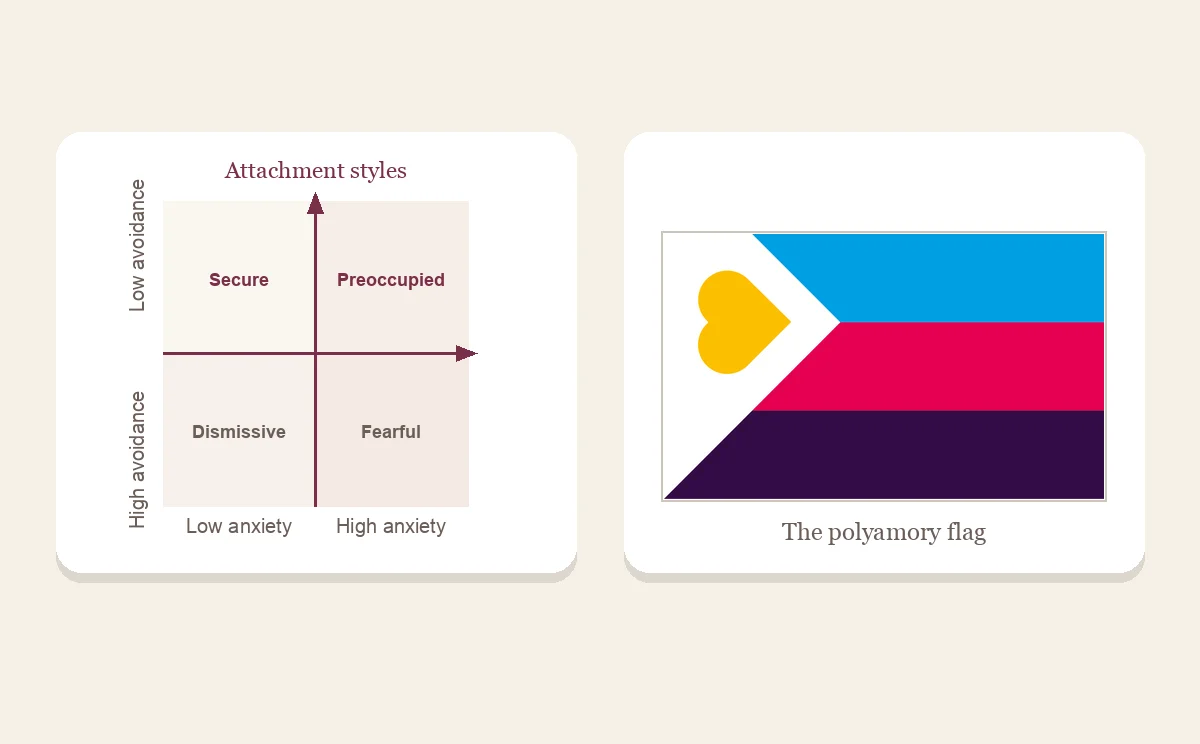
Modern research rarely uses the four neat categories you see on quizzes. Instead it measures two continuous dimensions. Anxiety is the fear that a partner will not be available, and it produces protest, reassurance-seeking and close attention to tone. Avoidance is discomfort with closeness itself, and it produces distance, self-reliance and a quiet insistence on keeping an exit clear.
Low scores on both describe a secure pattern. High anxiety with low avoidance reads as preoccupied. Low anxiety with high avoidance reads as dismissive. High on both reads as fearful-avoidant. Most people sit somewhere in the middle of those axes rather than in a corner, and the position shifts with circumstance and with the partner in question.
Why Attachment Style and Polyamory Get Mentioned Together
Two claims circulate constantly, and they point in opposite directions. The first says that non-monogamy is a refuge for the insecure: anxious people collect partners to quiet a fear of abandonment, and avoidant people collect partners to dilute intimacy with any one of them. The second says that polyamory demands unusual security, so anyone doing it well must already be securely attached.
Both stories are old, and both are testable. What makes attachment style and polyamory worth treating together is that the second story turned out to be closer to the data, with one qualification that the slogans quietly drop.
What Adding a Partner Changes
Polyamory changes the arithmetic of closeness. Because non-monogamy spreads time, attention and reassurance across partners, those resources now come divided. For someone whose attachment system is sensitive to absence, that division is a live test. Where a monogamous couple might drift for a week and notice nothing, a polyamorous arrangement makes the drift visible on a calendar.
What It Does Not Change
The underlying pattern does not reset. Someone who needed explicit reassurance in one relationship will need it in the next. What can change is the shape the pattern takes. Several studies now suggest that attachment is best understood as relationship-specific rather than as a single global trait, which means you can feel secure with one partner and anxious with another.
What Attachment Style and Polyamory Research Actually Agrees On
Most of the empirical work here is recent, and nearly all of it is cross-sectional, which means it photographs a moment rather than following a life. Even so, a few findings repeat across independent samples.
People in Polyamorous Relationships Score Secure
The largest relevant study recruited 357 people in polyamorous relationships with at least two concurrent partners. On average, they scored lower on both anxiety and avoidance than established population norms. In plain terms, the sample looked more secure than the general adult population, not less. Participants also reported generally satisfying and committed relationships with each partner.
A second study compared people in consensual non-monogamous relationships against a monogamous comparison group. The non-monogamous group reported lower avoidance. Anxiety did not differ between the two groups at all. That asymmetry matters, and it is where the simple story starts to come apart.
Avoidance and Anxiety Predict Different Things
In one study of people who had never practiced non-monogamy, avoidance predicted warmer attitudes toward it and a greater stated willingness to try. Anxiety predicted the opposite. Yet among people actually practicing it, avoidance was the lower trait, and anxiety made no difference to engagement. Different parts of the pattern govern wanting something and doing it well.
Where Attachment Style and Polyamory Research Diverges
The findings above are consistent, but they are also small, and they disagree with each other in the details. Some work finds that positive attitudes toward non-monogamy correlate with insecurity, at least in people who have never tried it. Other work finds the reverse in people who have. Avoidance is the pivot. It predicts curiosity, and it also predicts worse outcomes once a relationship actually exists.
Meanwhile, the research on emotion regulation complicates the picture further. One study found that among people high in avoidance, the usual link between positive attitudes and sexual satisfaction flipped negative. A good attitude, in that group, appeared to be covering for real discomfort with closeness rather than expressing genuine enthusiasm.
One further finding deserves a mention because it is structural rather than psychological. Hierarchical arrangements, in which one relationship is formally ranked above the others, were associated with lower satisfaction and lower attachment security than non-hierarchical ones. The shape of the structure can press on the pattern, not only the reverse.
The Four Patterns, Translated
Categories are blunt instruments, but they are easier to hold in your head than two abstract axes. Read each of these as a tendency rather than as a diagnosis.
Secure, Anxious, Avoidant, Fearful
Secure people assume their partners will show up and can ask for comfort without a script. Anxious people track every shift in tone and read ambiguity as danger. Avoidant people feel crowded by intensity and tend to solve distress alone. Fearful people want closeness and expect it to hurt, so they swing between reaching and retreating.
None of these is a sentence. Patterns shift with therapy, with a steady partner, and with plain practice. What does not help is treating a quiz result as a fixed identity and then building a relationship structure around the limitation.
Your Attachment Style Is Not a Verdict
The most damaging folk belief in this area runs like this: insecure people should not attempt polyamory. That is not what the evidence says, and it is also a poor rule to live by. Anxiety and avoidance are not disqualifications. Instead they are tendencies that predict where the difficulty will show up.
The Measurement Problem
There is a technical reason to hold all of these findings loosely. The standard attachment questionnaires all assume a couple. Hand one to a person with three partners and they face an absurd choice: answer it three times, pick a partner arbitrarily, or average their partners into a fictional composite. Nobody has demonstrated what the resulting number means.
Samples are a further problem. Most exist because people volunteered through community groups and social media, which selects for the organized, the online and the out. People who practice non-monogamy quietly simply are absent from the data, however many of them there are.
Attachment Style and Polyamory: Putting It to Work
If you want something actionable, stop asking whether your type is allowed to do this. Start asking where your particular pattern will cause friction, and then design around that instead.
If You Lean Anxious
Name the fear in specific terms rather than requesting blanket reassurance. “I am worried about being replaced” is workable. “Do you still love me” is not, because no answer survives until the next day. Then notice that the relief from reassurance fades quickly, while the relief from information tends to hold.
Then build a structure that does not depend on improvisation. Predictable check-ins, agreed expectations, and a standing rule that plans do not change silently will do more for an anxious attachment than any amount of willpower. Solid boundaries rather than rules protect the person who needs them most.
If You Lean Avoidant
Your risk is not jealousy. It is distance that looks like calm. When a partner’s need arrives, the urge to go quiet and handle it alone is the pattern talking rather than wisdom. Say what you are doing. “I need an hour, and I am not leaving” is a sentence that costs you little and saves a partner an enormous amount of interpretation.
Because avoidance predicts lower satisfaction with each relationship it touches, this is the dimension with the clearest practical cost. Naming it early, and asking a partner to call it out when it shows, is the cheapest intervention available. The scripts for hard conversations are worth having ready for exactly this.
Myths About Attachment Style and Polyamory
Several confident claims deserve retiring. The first is that non-monogamy attracts the insecure. Evidence from people who actually practice it points the other way. A second claim holds that a secure attachment style is required. It is not required; it is the pattern most rewarded by the structure, which is a different and much narrower claim.
“Some people just aren’t wired for it”
This sounds like a verdict on personality, but it usually describes a pattern nobody has managed yet. Anxious people can flourish in polyamory given clear agreements. Avoidant people can flourish if they stay in the room rather than leaving it. What breaks is not the person. It is the mismatch between a pattern and a structure that nobody discussed in advance.
Attachment Style and Polyamory: What to Do Next
Start with honesty rather than a quiz. Notice where you reach, where you retreat, and which of your relationships leaves you feeling most settled. If the pattern differs across partners, take that seriously, because it means the variable is partly the relationship rather than only you.
Then read about the mechanics rather than the labels. Understanding how jealousy behaves is more useful than knowing your type. So is understanding how an existing partner’s other partner fits into your own attachment map, and how to set expectations clearly enough that nobody has to guess.
Finally, treat all of this as provisional. The research on attachment style and polyamory is young, most of it was never designed to answer the question it is now being asked, and the next decade will overturn parts of what passes for settled knowledge today. The overlap with neurodivergence is a good reminder that simple explanations rarely survive contact with real people. What will not change is the underlying skill: noticing your own pattern before it runs the conversation for you.
If you are near the beginning, what polyamory actually means is the right place to start, and it is worth reading how attachment theory was built in the first place. Neither will tell you who to be. Both will help you recognize the moment your own habit takes the wheel.