Kink and the ENM Community: Where Kink and Polyamory Overlap
Ask most people what happens at a polyamory meetup and they picture a club night: leather, ropes, a dress code. That picture is wrong in two directions at once. Kink and polyamory are separate things that happen to share a lot of people and a lot of stigma. Working out where they overlap, and where they do not, is the difference between understanding two communities and flattening them into one.
Start with the definitions, because the confusion lives there. Polyamory is about who you love, and how many relationships you build at the same time. Kink is about what you do, and which kinds of erotic play you find compelling. A person can be thoroughly kinky and strictly monogamous. Another person can have three partners and no interest in bondage at all. Neither arrangement says anything about the other.
Still, the two worlds touch constantly. The same conferences, the same forums, often the same friends. Below is what the research documents about that junction, why the confusion persists, and what it means if you live on both sides of it.
Kink and Polyamory Are Two Different Axes
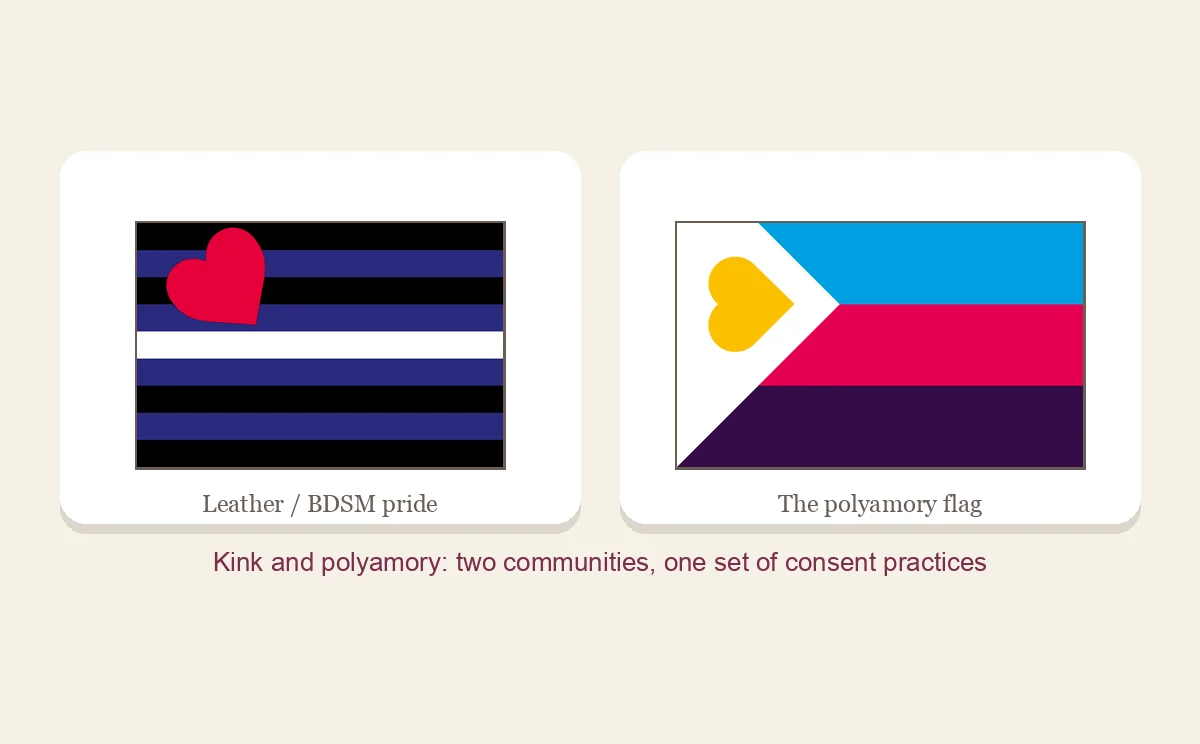
Researchers treat these as independent dimensions rather than points on one line. Consensual non-monogamy describes relationship structure: whether you have more than one romantic or sexual partner, with everyone’s knowledge and agreement. BDSM describes practices and roles. That means bondage and discipline, dominance and submission, sadism and masochism, plus a long tail of fetishes that have nothing to do with power at all.
Because the two axes are independent, all four combinations turn up. Plenty of monogamous kink practitioners have belonged to a scene for twenty years. Plenty of polyamorous people have a bedroom life that is entirely vanilla. Others are both, and still others are neither. The overlap is a sizable minority of each community, which is exactly why outsiders keep mistaking the two for each other.
How Common Either One Actually Is
Prevalence numbers are softer than headlines suggest, but the shape of the finding holds. In 2017, Debby Herbenick and colleagues reported that roughly 30% of American adults had some experience with kink activities. Far fewer identify with the communities built around them. That same year, Justin Haupert and colleagues used two nationally representative samples. They estimated that about 20% of Americans had practiced consensual non-monogamy at some point.
Both figures describe lifetime experience rather than current practice. A much smaller slice of the population is in a non-monogamous relationship right now. Smaller still is formally part of an organized scene. The practical point stands regardless. Both are common enough to encounter, and neither is a fringe curiosity. They are also common enough to overlap. Surveys of kink practitioners routinely find a substantial minority who are also non-monogamous.
If any of this is new to you, what polyamory actually means in practice beats a definition. And our beginner’s guide covers the vocabulary you will hear at a first community event.
Why the Two Communities Get Confused
Part of the confusion is historical. Modern kink communities and modern polyamory communities grew up alongside each other. In many cities they share a venue, a mailing list, and a set of norms. Both developed elaborate consent practices: negotiation before play, agreed stop signals, the principle that you agree to specific acts rather than to a whole person. Each borrowed freely from the other.
Part of it is stigma. Outsiders rarely distinguish between the two. They lump kink and polyamory into the same disapproving sentence. A landlord who learns about a partner’s lifestyle, a manager who hears about a rope class, a relative who stumbles onto a dating profile: the reaction tends to be identical whether the discovery is one, the other, or both. Shared exposure creates a shared defensive posture, and a shared shorthand.
Finally, popular culture deserves some blame. It has spent a decade selling an image of glamorous, leather-clad non-monogamy. That image folds two distinct subcultures into a single aesthetic. Meanwhile, the actual communities are full of people who would not recognize themselves in it.
What the Research Shows About Kink and Polyamory
The clearest window into the junction comes from a 2022 study in the Archives of Sexual Behavior. Thomson Ling and colleagues analyzed 67 written narratives gathered by the National Coalition for Sexual Freedom. The participants had taken part in kink, BDSM, non-monogamy, or polyamory. The authors wanted the messy incidents rather than the theory: discrimination, harassment, coming out, being outed, consent violations, and assault.
A single set of themes emerged, cutting across both groups. Participants described the same negotiating script, the same fear of disclosure, the same calculation about who to tell. That is the finding worth holding onto. Kink and polyamory are not merely adjacent in social terms. They generate the same kinds of stories, because they expose people to the same structural risk.
A 2022 review by D. J. Williams reached a compatible conclusion from another direction. Summarizing the research on kink, Williams described notable diversity in gender, sexual orientation, and relationship style within kink samples. He also reported higher levels of suicidal thinking linked to minority stress. Being marginalized on two counts at once does not double the harm by any simple arithmetic. But the pressures do stack.
Consent Is the Shared Grammar
If one practice unites the two communities, it is consent. Both built formal negotiation out of necessity, because both involve things that carry physical, emotional, and legal risk. The result is a culture with an unusually explicit vocabulary: prior consent, informed consent, ongoing consent, limits, stop signals, aftercare, debriefing.
The evidence suggests that culture does real work. In 2020, the National Coalition for Sexual Freedom ran a consent survey with researchers at UNC Charlotte. Within alt-sex contexts, respondents reported ordinary sexual acts as the most common consent violations. Unwanted touching, oral sex, and penetration outranked the BDSM practices outsiders fear most. More than 90% of respondents enjoyed bondage and spanking, yet those acts appeared in fewer than 10% of the reported violations. Negotiated kink, it turns out, is not the dangerous part.
That result is worth sitting with, and it is no argument for complacency. It means the protections these communities built are doing their job. The negotiation, the check-ins, the explicit agreement: all of it is working. It also means that kink and polyamory alike need those protections to cover sexual contact as carefully as they cover a scene. Consent is not a formality here. In both worlds it is the load-bearing wall, and the boundaries rather than rules that hold up best are the ones everyone agreed to in advance.
Where the Overlap Is Real and Where It Is Assumed
Casual conversation merges two claims that deserve separating. The first is statistical: a meaningful share of people in each community also belong to the other. The evidence supports that. The second is conceptual: that kink and polyamory are two expressions of a single underlying appetite for novelty or nonconformity. Nothing supports that, and treating it as true flattens both.
People come to kink for reasons involving sensation, ritual, power, trust, and play. People come to polyamory for reasons involving love, autonomy, and the shape of the life they want. The motives barely resemble one another. What the two communities share is not a cause but a condition. Both live outside a norm that most people never have to justify.
Finding Kink-Aware and Poly-Aware Care
The overlap shows up most sharply in professional settings. A 2024 survey ran by the National Coalition for Sexual Freedom with UNC Charlotte asked 998 professionals about their attitudes toward kink and consensual non-monogamy. The group included therapists, physicians, nurses, and others. Nearly one in three reported experiencing stigma connected to their own practice. Almost half did not know that kink-aware clinical guidelines exist.
For anyone living at the intersection of kink and polyamory, that gap has consequences. Finding a therapist who will not treat a relationship structure as a symptom, or a kink as a disorder, is a real obstacle. So is the reverse case: a clinician who is entirely comfortable with non-monogamy but has never once thought about power exchange. The useful question to ask a prospective provider is narrow and concrete. Have you worked with clients in these communities before? A vague answer is itself an answer.
What to Do If You Are in Both
If you navigate kink and polyamory at the same time, the two identities can reinforce each other or quietly compete. Reinforcement is easier when one person knows both things about you. Then you are not maintaining two separate versions of yourself for two separate sets of friends. Competition is more common than people admit. A rope class, a play party, and a partner’s birthday can all land on the same Saturday.
Two habits help. First, name the separate needs. The desire for a scene and the desire for another relationship are different appetites. Collapsing them produces a partner recruited for a role they never agreed to play. Second, keep the calendars honest. Polyamory runs on logistics and kink runs on recovery time. Neither survives being treated as an afterthought.
Jealousy deserves its own line here, because it turns up in both worlds for slightly different reasons. In polyamory it usually attaches to a person: a metamour, a new partner, someone who seems to get more attention. In kink it more often attaches to a role or a skill, and to the fear of being replaced at something you thought was yours. The triggers differ; the remedies do not. A good jealousy toolkit works in either setting, and so do the scripts for hard conversations that both communities pass around.
Kink and Polyamory: Two Communities, One Border
The urge to merge the two communities is understandable, and mostly harmless in private life. In public it costs something. When outsiders assume that kink and polyamory are the same movement, newcomers arrive at a munch expecting a spectacle rather than a conversation. People who might have found a home in one scene get warned off the other.
Precision is a courtesy to both. Saying that kink and polyamory share a culture of consent without sharing a definition is not a technicality. It is what lets a monogamous submissive and a vanilla triad recognize each other as neighbors rather than relatives.
So the honest summary is this. Two communities, one border, plenty of traffic across it, and no requirement that anyone hold dual citizenship. If you are in one, you are not automatically in the other. If you are in both, you already know that the overlap is not the interesting part. The interesting part is that both ask the same question — how do you love and touch people without doing them harm — and answer it in their own accent.