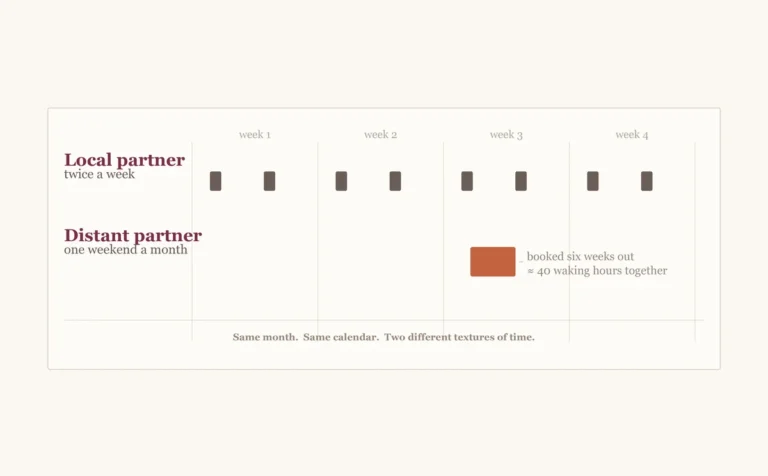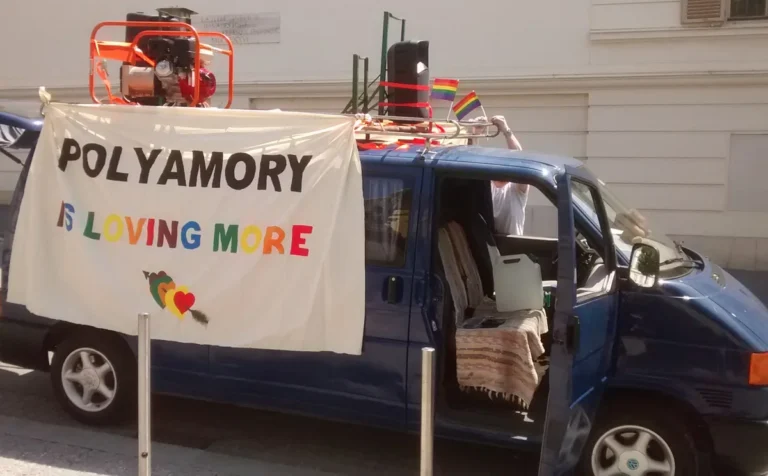
Solo Polyamory: Building a Life That Doesn’t Aim at Coupling
People usually describe solo polyamory as a stage rather than a life. Mostly, they frame it as something you do between primary partners, or after one, or while you wait to become somebody’s person. That description is wrong, and it is expensive. It shapes how landlords, families and new partners treat the arrangement. And it shapes how the people living inside it plan their money and their years.
What follows is the practical version. Not a manifesto about independence, and not an argument that coupling is a lesser choice. Instead, it is an honest account of what a solo polyamorous life actually costs, what it protects, and which questions are worth answering before you build one.
What Solo Polyamory Actually Means
Solo polyamory means you have romantic and sexual relationships with more than one person while remaining your own primary partner. And you do not merge households, bank accounts or long-term plans with any of them. You are not single in the sense of being unattached. Nor are you celibate, and you may well approve of hierarchy in principle. In practice, though, the arrangement spreads priority around rather than ranking it once and for all.
The word solo describes the shape of a life, not the number of people in it. In fact, plenty of solo polyamorous people have three partners and a full calendar. Others, meanwhile, have one partner and a wide circle of friends. The common thread runs the other way, because other people’s plans never get to quietly become your structure.
Interest is not rare, either. About one in six American adults say they would like to practice polyamory. Roughly one in nine have done so at some point, according to a national survey of single adults. Yet what people rarely report is how they plan to live while they do it, which is where the rest of this piece goes.
The Solo Part Is a Housing Decision First
In practice, housing is where the philosophy meets the lease. A solo polyamory life usually means one name on a rental agreement and one set of bills. It also means a home sized for the person who actually lives in it. That is a decision about money before it is a decision about love, and relatives will second-guess it more than any other.
Roughly 29% of American households now hold a single person, according to the Census Bureau’s 2024 estimates. Living alone is ordinary rather than eccentric. Still, the arithmetic differs. You carry the whole rent instead of half. That often means a smaller place, a longer commute, or housemates who are not partners at all. Because that is a financial fact, it deserves a financial plan.
One habit is worth adopting early. Work out what you can pay alone in an ordinary month, with no partner’s contribution assumed. Then rent at or below that number. Meanwhile, the alternative, a lovely flat that needs a second income to be comfortable, is an escalator with furniture on it.
What One Name on the Lease Buys You
Above all, it buys refusal as a real option. If a relationship ends badly, you do not renegotiate your housing while grieving. When a partner asks to move in, that becomes a choice rather than a cost you are avoiding. And if the boiler dies at eleven at night, the person who calls the landlord is you. That is the same freedom wearing work clothes.
Money Without a Shared Account
Separate finances are the default in solo polyamory, and the honest reason is not distrust. Shared money creates shared decisions, and shared decisions create exactly the coupling you have chosen not to build your life around. So you keep your own account, your own savings and your own emergency fund. You pay for dates and travel as you go.
That arrangement creates one problem worth planning for, because the couple discount is real. For a start, holidays cost more per person. Hotel rooms cost more per person. And insurance and pensions, in most countries, still assume a spouse. Over ten years, those gaps add up to a sum nobody budgets for, mostly because nobody names it.
So name it. Keep an emergency fund built for one, holding enough to cover a deposit and two months of rent. Also write down who pays for what with each partner, especially on travel, and revisit the list when incomes change. And if you are the higher earner in every relationship you have, be honest about the power that buys.
Solo Polyamory and the Plus-One Problem
Weddings, work parties, funerals and family holidays all arrive with a seat count attached, and the count assumes a couple. As a solo polyamorous person you may have several people you could bring. After all, you have no rule for choosing between them. And you have an audience that will read your choice as a verdict on the relationships you left at home.
There is no elegant solution here, only an honest one. Decide early, and tell everyone involved before the reply card goes back. Rotating who you bring is fair if the rotation is understood. Bringing the same partner every time is also fair, provided the others are not quietly keeping score. What damages relationships is the surprise, especially for a partner who learns from a photograph that nobody invited them.
Meanwhile, your partner’s other partners are making the same calculation in reverse. Sometimes the fairest outcome is that nobody gets the wedding and everybody knows why in advance.
When People Read You as Between Relationships
Still, the assumptions arrive in ordinary sentences. A colleague asks when you are going to settle down. A relative offers to introduce you to someone nice. Then a new doctor asks for your partner’s name and the form has room for one. None of it is malicious. All of it carries the same message: they are reading your life as a waiting room.
The Assumption Inside the Question
Underneath the question sits a model of adulthood in which a person becomes real once they couple. Answering it well is less about defending polyamory than about refusing the premise. After all, “I’m not looking” is a complete sentence. So is “I have partners and I live alone by choice.” And you owe nobody the reassuring follow-up.
Inside polyamorous communities, the same assumption wears a friendlier costume. Then the idea gets said out loud: solo polyamory is what people do before they find their real partner. So correct that early with new partners. Otherwise it is the belief that turns a clear arrangement into a slow disappointment.
Solo Polyamory Is Not a Fear of Commitment
This is the most common misreading, and it deserves a direct answer. Solo polyamory asks for more commitment than most coupled arrangements, not less. You maintain several relationships at once, each with its own negotiations. And you have no shared lease to hold any of them together when things get hard. What you decline is one specific commitment, the escalator that runs from dating to living together to marriage to children. But you do not decline commitment itself.
You can tell the difference by watching what someone does when a relationship gets difficult. A person avoiding intimacy leaves. A solo polyamorous person stays, and works on it, and keeps their own address while doing so. Where the work happens is the distinguishing feature, not whether it happens.
That said, the two can be confused from the outside, and occasionally from the inside. If you keep choosing unavailable people, and living alone protects you from ever being asked for more, the honest next step is a good therapist. It is not a better label. Freedom and avoidance use the same furniture.
The Hard Parts, Named Plainly
Solo polyamory carries real costs, and pretending otherwise weakens every argument in its favor. Three of them are worth saying out loud.
Then there is illness. When you are sick enough to need help, the person who shows up is usually the one who lives with you. By design, that person does not exist. The second is money in a crisis. Because a shared household absorbs a lost job in a way that a single income never can. The third is the dull admin of naming who to call and who holds a spare key. It also means naming who may make a decision when you cannot.
None of that has a policy solution. Instead, ordinary preparation does. Name an emergency contact who actually knows your partners. Also leave spare keys with more than one person. Then write a will and a medical directive that say what you want, and keep friendships that do not depend on romance to survive.
The Night Nobody Is on the Other Side of the Bed
Sometimes the flat is quiet in a way that is not peaceful. Admitting that matters, because the community’s cheerful framing can leave people ashamed of ordinary loneliness. Living alone and feeling lonely are different states, and they alternate. So the useful question is not whether you are lonely. It is who you would call tonight, and when you last spoke to them.
Research on people who prefer single life points the same way. The psychologist Bella DePaulo has argued for years that single people who build their lives around chosen relationships report lower loneliness and stronger friendships than the stereotype allows. And surveys of more than twenty thousand adults across a hundred countries back her up. The variable is not a partner. It is whether the relationships are tended.
What Solo Polyamory Asks of Your Partners
Being someone’s solo partner comes with terms, and the kindest thing you can do is state them plainly and early. Your solo polyamory is not a phase you expect to grow out of. You are not going to move in, at least not on anyone’s usual timetable. Nor will you become the person everyone assumes at the end of the evening. You are not a placeholder while they wait for something more conventional.
Say that in the first few dates, not during the first vulnerable conversation. Then state it as an agreement rather than a rule. The difference matters more than it sounds. The piece on boundaries in polyamorous relationships explains why an agreement can be renegotiated without anyone losing face. And then hold to it, which includes letting people leave. A partner who wants to build a household is not wrong, and a slow exit is crueler than a clear one.
The same terms apply in reverse. If your partner has a nesting relationship, your calendar will be shaped by decisions you do not attend. Some evenings you will spend waiting for a message. Naming that in advance makes it a known cost instead of an accumulating grievance. And the jealousy that comes with it has its own tools that actually work. For the mechanics of that arrangement, our piece on when a marriage stops being primary is the honest companion.
How to Tell Whether Solo Polyamory Is Yours
Labels are cheap. The useful question is not what you call yourself. It is how you want your ordinary weeks to run. Five questions get most of the way there.
Do you want to be somebody’s default? When a partner has a bad day, do you want to be the first call or a good one? Does a joint bank account sound like intimacy or like supervision? When you picture a Tuesday ten years from now, is there another person’s coat by the door? And do you want to be needed every day, or chosen again and again?
Still, none of those answers is a verdict. Plenty of people want to nest and keep several relationships at once, and that is a different life, equally legible. What matters is that you chose the answer, rather than inheriting it from the last relationship that did not work out. If you are still working out where you sit, read the guide to how to start polyamory next. Solo polyamory is one room in that house, not the whole building.
A Life Built Deliberately
Solo polyamory is not a rejection of love and not a stop on the way to it. It is a decision about where the center of a life sits. Make it early enough that you arrange your housing, money and holidays around it, rather than retrofitting them afterward.
That is harder than it sounds, and it is worth doing in the open. Tell your partners what you are building. Then tell your family when it is safe to. Keep the friendships that predate every romance. And check once a year whether the life you have arranged is still the one you would choose. The point was never to live alone. The point was to choose.