How to De-escalate a Relationship on Purpose

Most relationships do not end because somebody decided to end them. They end by default. The Tuesday nights stop, the texts thin out, and nobody ever says out loud that the shape has changed. To de-escalate a relationship on purpose is to do the opposite: name the change while there is still enough goodwill to negotiate it, and keep the person when what you actually want to shed is a set of expectations.
That is a different job from breaking up, and it needs different tools. What follows is the practical version, from the opening sentence to the logistics most people forget until they are already resentful.
What It Actually Means to De-escalate a Relationship
De-escalation means reducing the commitments a relationship carries while keeping the relationship. Fewer shared evenings, no more joint calendar, perhaps no more sex, perhaps no more decisions about each other’s housing.
Notice that the commitments are what gets renegotiated. The affection usually does not. That distinction makes the conversation survivable, because you are not telling a person they matter less. You are telling them the scaffolding around the connection needs to come down a level.
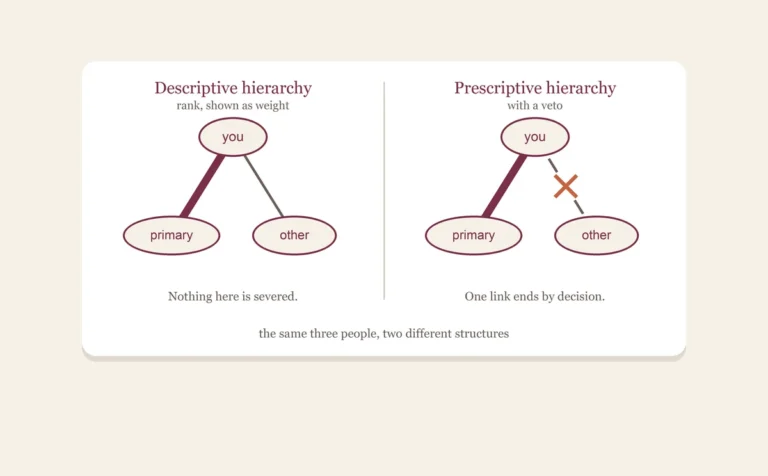
Polyamorous relationships de-escalate more often than monogamous ones, simply because they carry more moving parts. One partner can move from nesting to living alone. A triad can settle into a V. And a relationship that carried rank can become something with no rank at all, which is often harder to describe than to live.
De-escalating a Relationship Is Not a Slow Fade
The most common mistake is treating the decision to de-escalate a relationship as something you do quietly. You answer a little slower. You stop proposing plans. Eventually the other person works out that they have been demoted, and the discovery does the damage the conversation would have prevented.
A slow fade also leaves you with no agreement to point at later. When a mutual friend asks whether you are still together, neither of you can answer with confidence. Compare that with a plain sentence: “I want to keep seeing you, and I want to stop being your emergency contact.” At least that gives both people something solid to react to.
There is a related shape worth separating out. When a relationship drifts into friendship without anyone choosing it, that is a different animal from a decision, and it usually needs a different conversation. Choosing to step down is a plan. Drifting is weather.
The Signs You’re Already Doing It by Accident
Before you open your mouth, check whether you are already de-escalating a relationship by accident. The tell is a shrinking calendar, messages that used to get instant replies, and a growing list of topics you avoid because they now sound like demands.
It also looks like relief. If you feel lighter on the weeks you do not see somebody, that is data. So say it out loud rather than acting on it silently.
Meanwhile, the other person is usually tracking the same numbers and drawing worse conclusions. Silence reads as rejection far more reliably than a plain sentence does. Say the sentence, then, and say it before the resentment has time to settle.

Why De-escalating a Relationship Feels Impossible
Almost nobody avoids this talk because they are lazy. They avoid it because two fears collide at once: the fear of hurting someone, and the fear of being told the smaller version is not wanted at all.
Both fears are reasonable, and both are survivable. But notice what they produce in the meantime. You rehearse the conversation for weeks, the other person reads the distance as contempt, and by the time you speak, the relationship is already several degrees colder than the one you were trying to protect.
There is also a practical reason people stall. De-escalation has no ritual. Marriage has a ceremony, divorce has a process, and stepping a relationship down a level has nothing but a sentence you have to invent yourself. Consequently the sentence below matters more than it looks. Borrowing another person’s words is easier than finding your own.
Deciding What You Want to Keep
Go into the conversation with a list, not a verdict. Verdicts invite arguments about who is right. Lists invite negotiation about what is possible.
Write down three columns: what you want to keep, what you want to stop, and what you genuinely do not mind either way. Keep the first column generous. Most people in this position still want the person’s company, their humor, their advice, their dog. Naming those things first changes the temperature of the whole discussion.
This is the step most people skip, and it is why the talk goes sideways. If you arrive having decided to de-escalate a relationship without having decided what you are keeping, every concession sounds like a loss.
Then decide the physical shape before you discuss it. Overnight stays, sex, holidays, money, and living arrangements are the five levers, and each one moves independently. A couple who only discuss “how often” tend to leave with an agreement nobody can actually follow.
How to De-escalate a Relationship: Opening the Conversation
Do not lead with the problem. Lead with the relationship’s value, then the change, then the invitation. Something like: “I want to keep you in my life, and I have been pretending I can keep everything else the same. Can we talk about what this looks like now?”
Time it deliberately. A weekday evening with no other plans beats a Sunday night before a work week, and it beats any conversation conducted by text. If you are the one asking, you are also the one who owes the other person a real sitting-down slot rather than a message between meetings.
Expect the first reaction to be about safety rather than logistics. People hear “less” and assume “gone”. So repeat the first half of your sentence until it lands: you are trying to protect the relationship, not bury it.
Scripts help more than most people admit. If you freeze in hard conversations, borrow the structure from these conversation scripts and adapt the wording, rather than improvising your way through the most important talk of the year.
Also decide in advance what you will do if the answer is anger. Name it, sit with it, and do not treat the first flash of hurt as a verdict on the whole idea. The Gottman Institute’s work on criticism and contempt in conflict is blunt about what happens when a hard conversation turns into a character assessment: the content stops mattering and the tone does all the talking. Say what you need in the first person, and keep the other person’s flaws out of it.
Writing Down the New Shape
Once you agree on something, write it down. Not as a contract with penalties, but as a shared note you can both reread when memory and mood disagree.
Two or three sentences is enough. “We see each other most Thursdays. Texting happens when there is something to say. Neither of us is the other’s plus-one for family events. We check in about this in three months.” That note prevents a good share of the arguments that follow, because it removes the guesswork about what was actually promised.
Keep the note editable. A de-escalated relationship is a direction rather than a single event, and a shape that fits in March may not fit in September. So revisit it before either of you has a grievance to bring.
The Logistics Nobody Plans For
Most people treat the feelings as the hard part of de-escalating a relationship. In reality the logistics are where it breaks.
Money and housing cause more damage here than feelings do. If you share a lease, work out who stays and when, in writing, before either of you has a bad week. If you share subscriptions, accounts, or a car, untangle them on a schedule rather than in a crisis.
Calendars come next. The standing weekend, the family wedding, the friend group’s monthly dinner. Decide which of those you still attend together and which you stop. Vague answers here create a year of small humiliations.
Finally, agree on who tells whom. Mutual friends will notice the change long before you announce it, and a short heads-up saves everybody from performing surprise at the next party.
How to De-escalate a Relationship Without Ending It
The strongest predictor of survival is whether both people can name the new shape without treating it as a loss. That means the person asking has to tolerate grief without relenting, and the person hearing it has to tolerate disappointment without withdrawing.
Practically, keep one ritual intact. A monthly walk, a shared television show, a standing phone call. Rituals carry continuity that intentions do not, and one reliable anchor does more for trust than a dozen promises about staying close.
Keep the affection visible, too. If touch was part of the relationship and is now off the table, say so plainly instead of letting each hug become a question. Ambiguity about physical limits is where de-escalation most often curdles into resentment.
Then expect a wobble around week six. That is when the novelty of the new arrangement wears off and the old expectations resurface. Book the check-in for exactly that point, and you will catch the drift while it is still cheap to correct.
What to Tell Other People
You owe nobody a full account. You do owe the people closest to you enough truth that they are not embarrassed later. A single sentence usually covers it: “We are still together, and we are not doing the whole shared-life thing anymore.”
If somebody pushes for detail, name the decision once and stop. Something like “we de-escalated a relationship, and that is the whole story” closes the topic without denying it. Anyone who treats the news as a scandal is telling you something about their own arrangements.
Metamours need slightly more. If your partner’s other partner has been scheduling around your relationship, they deserve to know that the schedule changed, without the details of why. A metamour who learns it third-hand reads the silence as exclusion, and that is a needless injury.
Children, if there are any, need the least detail and the most reassurance. What changes for them is usually concrete: who is at breakfast, who does the school run. Answer at that level, and answer it more than once.
When De-escalating a Relationship Still Ends It
Sometimes the answer is no. A partner may not want a smaller version of what you had, and that is a legitimate position rather than a failure of flexibility. Some people would genuinely rather have a clean ending than a permanent negotiation.
If that happens, the honesty still pays. A relationship that ends after a real conversation tends to leave less wreckage than one that ends after six months of quiet withdrawal, and any friendship that follows is more likely to be genuine.
Watch for the case where de-escalation is a request in disguise. If you already know you want out and are offering a smaller arrangement to avoid saying so, tell the true thing instead. Half-honesty here costs more than a hard week, and it costs it twice.
Is It Possible to De-escalate a Relationship and Stay Close?
Yes, and it happens more often than the wider culture admits. The relationships that survive it tend to share a few habits: they talk early, they write things down, they keep one ritual, and they review the agreement instead of treating it as permanent.
They also clear the ground beforehand. A relationship that already ran on unspoken rules and scorekeeping will expose all of it the moment the shape changes. One that ran on boundaries both people understood finds the step down is mostly admin.
Jealousy still shows up, especially when one person’s new arrangement looks freer than the other’s. That is not a reason to abandon the plan. It is a reason to use the tools that make jealousy workable rather than pretending it is absent.
Polyamory does have an advantage here, and it is worth naming. The wider practice of polyamory already treats relationship shape as something negotiable rather than fixed, so a step down is a renegotiation rather than a scandal. That framing is the single most useful thing the community has to offer anybody attempting this.
Making the New Shape Last
Put a review on the calendar before you need one. Three months is a reasonable first interval, then six. The review is not a performance appraisal, and it is not a vote on whether to have de-escalated a relationship at all. It is a chance to say what is working and what has quietly stopped.
Expect the shape to move again. Some de-escalated relationships settle into something durable and warm. Others continue down the same slope until they reach friendship, or nothing at all. Both of those are acceptable endings, provided somebody said so out loud along the way.
The point of doing this deliberately is not to guarantee a particular outcome. What it does guarantee is that whatever happens next, neither of you has to reconstruct it from silence. That is a low bar, and it is the one most relationships miss.