New Relationship Energy: What It Is and How to Handle It
New relationship energy is the reason a forty-three-year-old adult with a mortgage and a sensible car will stay up until two in the morning texting. It is the early, high-voltage phase of a new romance: the appetite, the obsessive attention, the sense that a stranger has quietly become the most interesting person in the world. Polyamorous people did not invent it. They are simply the ones who have to manage it while somebody else waits at home.
This piece is about what that state actually is, why it fades, and how to keep it from doing damage to the relationships it lands on top of. I have written it for both sides of the equation, because in polyamory there almost always are two: the person in the rush, and the person watching it happen from the sofa.
Here is the short version. New relationship energy is a temporary, involuntary state of narrowed attention. It is real, it is chemically underwritten, and it makes a poor guide to long-term decisions. Enjoy it, name it out loud, and do not let it sign anything on your behalf.
What New Relationship Energy Actually Is
A working definition, then. New relationship energy is a temporary, involuntary, intensely rewarding state of attention. It narrows your focus to one person, inflates their virtues, and makes ordinary shared activities feel like discoveries. It also changes what you are willing to do, and that last part matters for everyone else in your life.
The phrase is younger than most people assume. Zhahai Stewart coined “new relationship energy” in the mid-1980s while trying to describe his own polyamorous relationships, and it spread through early online polyamory discussion in the early 1990s. He tells that story himself in his essay on the subject, which remains the clearest first-person account of the phenomenon.
Where the Term Came From
Stewart’s insight was that the experience needed a name because people kept mistaking it for evidence. When you stand inside it, the intensity feels like information about the person in front of you. Naming it as a state rather than a verdict is the whole point of the label. It also explains why the word caught on within months across a scattered community that had no web to spread it.
The concept sits close to limerence, the term Dorothy Tennov coined for the involuntary, obsessive quality of early romantic attachment. The two overlap heavily, but the difference matters. The older term can occur without any relationship existing at all. What Stewart named describes something narrower: the mutual, escalating state that builds between two people who are actually seeing each other, and the encyclopedia summary of the concept is a fair place to check the details.
The Chemistry, Briefly
Popular accounts of the neuroscience tend to sound more confident than the research is, so treat this paragraph as a sketch rather than a mechanism. What the evidence does support is narrower: early romantic attraction recruits the brain’s reward and motivation systems, the circuits tied to wanting something rather than to enjoying it once obtained. Novelty amplifies that response considerably.
So the experience is not a metaphor. Something is rewarding you, fairly literally, for paying attention to someone new. And because novelty drives the reward, the feeling has a half-life. That is not cynicism; it is the mechanism showing its seams.
Why New Relationship Energy Fades
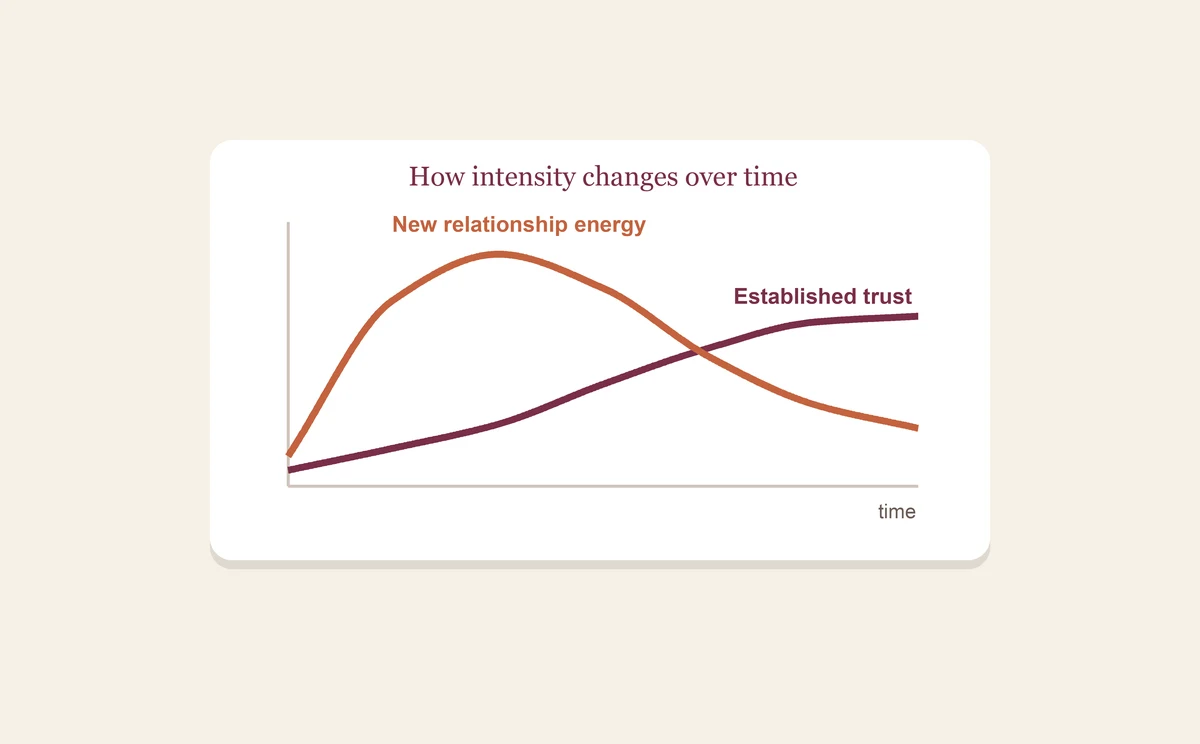
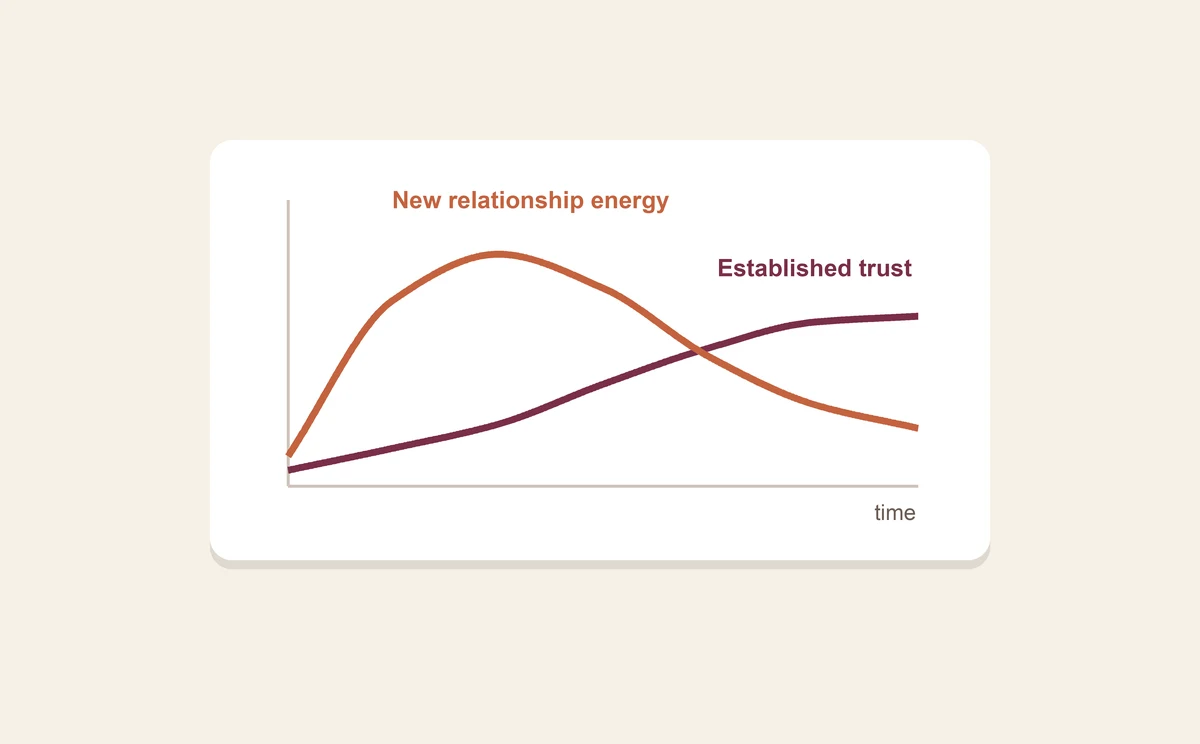
Every early romance has a shape: a steep climb, a peak, and a long slope down toward something steadier. The slope is not a malfunction. If you have ever moved in with someone and watched the thrilling version of them slowly become the familiar version, you have seen the curve at work.
The timeline varies more than people expect. Some people burn through it in eight weeks. Others stay lit up a year in, especially when the romance runs long-distance and every meeting counts as an event. Averages are unhelpful here, because the shape matters and the calendar rarely does.
The Decline Is Not a Verdict
This is where a lot of people hurt themselves. When the voltage drops, the honest reading is “this has become ordinary”, and the dishonest reading is “this was never real” or “we have a problem”. Neither misreading is useful, and the second one causes damage that outlives the feeling.
What has actually happened is that your attention has widened back out. You can concentrate at work again. You notice other people. The relationship has stopped being the only thing in the room, which is precisely the condition that makes it sustainable.
What Goes First
In most romances the appetite goes first, then the obsessive attention, then the sense of discovery. Affection tends to hold longer than any of them. Consequently, a relationship can feel considerably less exciting while being considerably more reliable, and both assessments can be accurate at once.
Of course, some of what fades was never really about the other person. Part of it was about being new to yourself in their company. That part does not come back with a different partner either, which is worth knowing before you go looking for it.
Why New Relationship Energy Shakes Established Partners
Monogamous people meet this problem too, just not at the same time. In polyamory the old relationship and the new one run side by side, so the contrast stays visible to everyone in the room, including the person who never asked to be compared.
The Comparison Nobody Can Help Making
Your established partner watches you light up for someone else and does the arithmetic without meaning to. They compare your enthusiasm now with your enthusiasm for them on a rainy Tuesday in February. That comparison is unfair and almost impossible to avoid.
Worse, it is partly accurate. You are more excited. You are also more distracted, more self-absorbed, and considerably worse at listening than you were last month. Your new partner gets the version of you that sleeps and eats; your long-term partner gets the version that answers email.
What the Older Partner Actually Sees
From the outside, the whole thing looks like your partner has been replaced by a slightly manic stranger who is very keen on somebody else. Small details register: a phone turned face down, a joke that needs explaining, a Saturday that used to be theirs and is now “up in the air”.
None of that is automatically a crisis. All of it is data. The partner who can say “you are not here this week” without turning it into an accusation is doing the hardest and most useful work in the house, and they should hear that somebody noticed.
How to Enjoy New Relationship Energy Without Breaking Anything
Nothing in this section asks you to suppress the feeling. Suppression does not work, and worse, it makes people dishonest. The aim is narrower: keep the rush from quietly rewriting agreements you never agreed to change.
Keep the Calendar Honest
The single most common damage here is logistical rather than emotional. You move dates, you cut calls short, the standing Tuesday becomes “probably”. Do the dull thing instead. Protect the commitments that existed before this person arrived, in the same shape you made them.
If you cannot keep a commitment, say so early and say why. Above all, do not quietly double-book and let the older relationship absorb the cost. It will notice the pattern before you do, and resentment compounds faster than desire does.
Say the Phase Out Loud
Name what is happening while it is happening. “I know I have been useless for three weeks, I am in the thick of it, and I need you to tell me when it gets too much.” That sentence costs you almost nothing and prevents months of silent keeping of score.
It also helps to tell your new partner the same thing. Being somebody’s new relationship energy is disorienting in its own way. You treat them as extraordinary, and by your own admission you are temporarily not yourself. The crash lands on them too when it arrives.
When New Relationship Energy Hits Your Household
If you are the partner at home, the useful question is not “how do I stop this” but “what do I need while it runs”. Those are different requests, and only another person can grant one of them.
Asking for What You Need
Ask for specifics rather than for reassurance. A weekly dinner that nobody cancels. A conversation before a new person becomes a fixture in your home. Hearing things before a mutual friend tells you. Specific asks can be met; “be less excited” cannot.
Then watch whether they honor the asks. Feeling a rush is not an excuse for being unreliable, and the community’s own accumulated wisdom is blunt here: you are expected to practice adjusting to the contrast between a new connection and an established one, rather than treating that adjustment as a personality trait you happen to lack.
If you are reading this because the ground moved and you feel like the least interesting person in your own kitchen, take that seriously rather than talking yourself out of it. Jealousy in this situation is not a character defect. Our piece on the jealousy tools that actually help is a better place to start than an argument at midnight.
What New Relationship Energy Is Not
It is not evidence that you have found your person. Intensity predicts compatibility poorly, and the people who chase it hardest tend to end up in serial monogamy with extra administrative steps.
It is not permission to dismantle something good. Some couples do seize a new connection as the reason to tear down an existing structure, and the excitement usually turns out to have done the reasoning. If you are genuinely considering stepping something down, our piece on when a romance quietly becomes a friendship describes the version of that decision made on purpose instead of in a hurry.
And it is not a fixed quantity you can summon by trying harder. You cannot manufacture novelty in a ten-year relationship by scheduling adventure, although adventure remains worth scheduling for its own sake. What you can build is the thing the novelty is competing with.
When It Fades, the Kinder Version
Most people meet the end of new relationship energy as a small grief, and it deserves the grief you would give anything else that mattered. The texts get shorter. You stop noticing what they are wearing. Some of the shine comes off, and what remains is a person you know extremely well.
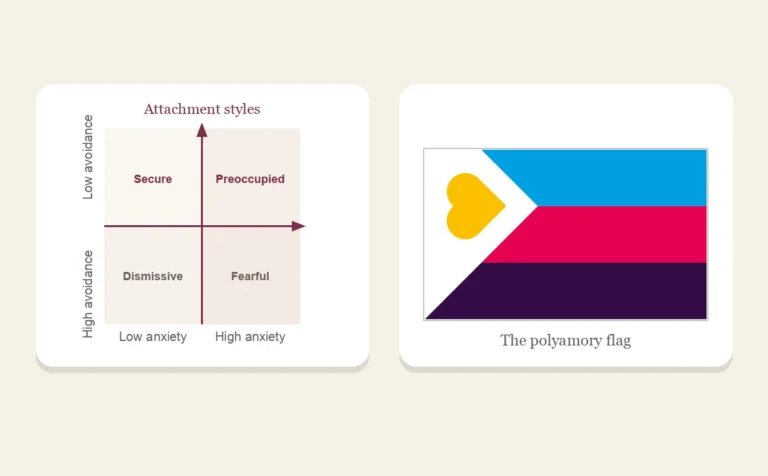
That is where the older, steadier feeling begins, and it is not a consolation prize. It is slower, less photogenic, and far more durable. It lets you be boring together, disagree without panic, and get through a genuinely bad year. If your attachment style runs anxious, the quiet can read as withdrawal, so check the difference before you panic.
One practical test, and it is nearly always decisive. After the excitement settles, do you still want to tell this person about your day, in detail, at length? If yes, the relationship has changed shape rather than failed. If no, that is also information, and it deserves a clear conversation rather than a slow drift.
The Long Version of the Same Feeling
New relationship energy gets all the good press, partly because it is easy to write about and partly because it looks like the plot of a film. The steadier thing that follows does not photograph well. It rarely makes anyone jealous and it almost never gets a montage.
Even so, it is the part most people say they would not trade. The households that survive running several relationships at once are rarely the ones with the most chemistry. They are the ones who learned to name a phase while standing inside it, keep the calendar they promised, and treat excitement as a season rather than a verdict.
Two habits do most of the work. The first is telling the truth early, to both partners, in small plain sentences. The second is deciding what you actually promised before the rush started, and then treating that list as binding even when it stops being fun.
For anyone newer to this way of living, the vocabulary rewards a slow approach. What a metamour is, how boundaries differ from rules, and what starting out actually looks like are the three pieces that make the rest of it legible. None of them is complicated. All of them are easier to learn before the rush arrives than during it.
If you are in the middle of one right now, enjoy it properly. Another person lighting you up is one of the genuinely good things about being alive, and holding back out of caution would be a waste. Just keep one hand on the calendar while you do it.