Dating While Polyamorous: Apps, Profiles, and Being Upfront
Dating while polyamorous means doing the hardest parts of dating in the open, before you know whether anything is worth protecting. Yet most apps were built for one person looking for one other person. The profile fields have no slot for “partnered and available,” and every new match carries a conversation you will eventually have to start. I got several of these wrong before I got them right, and the mistakes were almost never about the app.
The short version is this: the apps are the easy part. What separates a good experience from an exhausting one is how honestly you write, how early you disclose, and how well you handle the people who walk away.
Choosing the Right Apps for Dating While Polyamorous
Not every app handles non-monogamy the same way. Some make it a first-class setting, while others leave you explaining yourself in a bio field with a 500-character limit. Because that difference shapes who you meet, choose deliberately rather than downloading whatever your friends use.

What Each App Actually Gets Right
Feeld is the one app built around this from the start. You can link your profile to as many as five partners, filter by relationship type, and say plainly what you are looking for, so fewer conversations begin with a confession. The trade-off is size, since the pool in a mid-sized city can feel thin enough that familiar faces cycle past every few weeks.
OkCupid deserves more credit than it gets. It lets you set a relationship type, and if you list yourself as partnered or married, non-monogamous becomes the available setting rather than an afterthought. It also asks a long list of match questions, which sounds tedious and turns out to be useful. Answering twenty of them honestly tells a stranger more about you than a paragraph of adjectives.
Meanwhile, Tinder and Hinge are where most people start, and they are the hardest. Neither offers a relationship-structure field, so you write around the question in your bio. That is not dishonest, though it means more explaining and more mismatches discovered three messages in. Still, the larger pool matters, and if you live somewhere small the bigger app may be the only place with enough people to meet anyone.
Whichever you pick, one rule holds. Put the disclosure in your profile rather than saving it for the chat. Something like “ethically non-monogamous, partnered, looking for something real” filters out most people who were never going to be comfortable. Yes, it shrinks your matches. Yet it also spares you a dozen conversations that end the moment you tell the truth. See our guide to what polyamory actually is if you want the vocabulary settled first.
Writing an Honest Profile
A profile has two jobs that pull against each other. It should attract people who would actually fit your life, and it should not expose another person’s private business. The fix is a simple rule about whose information you are allowed to spend.
What to Include in a Dating While Polyamorous Profile
Include four things. Say that you are non-monogamous. Be clear about whether you have existing partners, without naming them. Describe what you are looking for, in words specific enough to be wrong. And mention what you bring, because “looking for a third” tells a reader nothing except that you have not thought about them yet.
Leave out everything that belongs to another person. Partner names, the shape of your polycule, a partner’s health, a partner’s jealousy, the argument you had last Tuesday: none of that is yours to publish. If a photo shows someone’s face, get their yes before it goes up. Consent on a profile is not a formality, because a profile is a public page any stranger can screenshot.
Specificity does most of the work. “I value deep conversation and emotional honesty” is a sentence that fits everyone and therefore describes no one. “I go to two live shows a month, I cook badly but enthusiastically, and I want a Tuesday-night person who does not need to be my whole world” fits maybe three people in your city, and those three will write back.
One practical note on photographs: a clear, recent, relaxed picture of your actual face does more for you than a clever bio, and group shots where nobody can tell which one you are do nothing at all.
When to Have the Disclosure Conversation
Disclose before the first date, in the app chat. Not because there is a moral deadline, but because a first date is a bad place to learn something that changes the shape of the evening. Once you are sitting across from someone you find attractive, the urge to soften the news gets very strong. Softened news is how people end up feeling tricked.
“Before we meet, I want to be straight with you. I am in an open relationship and I practice ethical non-monogamy. Everyone involved knows and consents. Is that something you are comfortable with, or curious about?”
Note what that message does not do. It does not apologize, it does not oversell, and it does not ask the other person to reassure you. Asking “is that okay?” and then waiting anxiously for a yes turns your honesty into their problem. Meanwhile, send it and let them answer at their own pace.
Expect a range of replies. Some will say “not for me,” which is a complete answer. Some will have questions, and a few will turn out to be polyamorous themselves and relieved you said it first. When someone is merely curious, give them a real answer rather than a sales pitch. Finally, the More Than Two resource library has better language than mine if you want to borrow it.
Handling Rejection When You Are Dating While Polyamorous
You will be rejected more often than a monogamous friend with the same face and the same charm. That is arithmetic, not a verdict on you. Non-monogamy is still a minority practice, so a smaller share of any pool is available, and the people who are available are often already saturated.
The rejections that sting are rarely the honest ones. A clean “that is not for me, good luck” costs almost nothing. What wears people down is the slow fade: the enthusiastic match who goes quiet after the disclosure, the three-day gap that becomes a week. When that happens, resist the urge to re-explain. One follow-up is reasonable. Still, a second is a request for a decision they have already made.
Protect yourself structurally rather than emotionally. Keep one evening a week that is not for dating, apps included. Then cap the conversations you are running at once, because a polyamorous life plus five active chats is a schedule problem disguised as abundance. And log off when the swipe fatigue starts, since tired swiping produces careless matches, and careless matches produce more of the rejection you were avoiding.
Boundaries help here more than willpower does. A boundary is a rule about your own conduct, which you can keep, rather than a rule about another person’s, which you cannot. Our piece on boundaries in polyamorous relationships explains why that distinction matters when you are dating.
Dating Monogamous People Honestly
Sometimes the person who fits is monogamous, and this can work. Still, it works far less often than people hope, so be precise about what working would require.
Ask three questions early, and listen to the answers rather than the tone. Are they curious about non-monogamy for themselves, or only tolerant of it for you? Do they have their own relationships and interests, or are they waiting at home? And when they say they are fine with it, what do they picture? The last matters most, because a partner who imagines you on dates and a partner who imagines you leaving are having two different relationships with the same facts.
Dating while polyamorous with a monogamous partner also guards against a slow imbalance. They are not seeing anyone, so your evenings out are a subtraction from their week while they are a gain in yours. That asymmetry is survivable, though only if the monogamous partner has a life that fills the same hours.
Beware the quiet hope that they will change, and be equally suspicious of your own hope that you will. A monogamous partner counting on you to outgrow this is not consenting to the life you are living, and a polyamorous person counting on them to come around is running the same gamble in reverse. Both bets feel like patience from the inside.
If the mismatch is real, end it earlier than feels polite, because the kindest version of that conversation happens at month two rather than month fourteen. Our piece on when a marriage stops being the primary relationship covers the harder version.
Meeting Metamours, and Why to Wait
The word for your partner’s other partner is metamour, and the relationship you have with them is its own relationship, with its own terms. That is the part new people underestimate. You are not meeting an extension of your partner. Instead, you are meeting an adult with a separate opinion about you.
My rule is to wait. Let a new connection establish its own shape before introducing it to the wider network, because a relationship that is three weeks old cannot survive four people’s advice. Integration works better once the new thing has a floor under it. If the word is new to you, our guide to what a metamour is is the short version.
When the meeting happens, keep it short and low-stakes. Coffee, an hour, a public place, and no expectation that anyone becomes friends. Some metamours become close, some stay cordial strangers, and both are fine outcomes. The goal is not a happy family photograph. The goal is that nobody has to manage a surprise.
One caution for the partnered reader. Do not send your new partner to meet your established partner as a test, and do not let an established partner set the terms of a relationship they are not in. Your partners get to have opinions about their own lives. They do not get a veto over another person’s, and treating a metamour as an approval step is how a network turns into a hierarchy with extra paperwork.
Safer Sex Conversations in Dating While Polyamorous
These conversations come earlier and more explicitly than they do in monogamous dating, and that is a feature rather than a cost. More partners means more paths for an infection to travel, so the conversation is not an awkward preamble. It is the responsible part of the arrangement, and the American Sexual Health Association’s safer sex guidance is a better starting point than any forum thread.
What to Say Before the Second Date
I have this conversation by text before the second date, while either of us can still change our minds calmly. Mine goes roughly like this: tested every three months, barriers with new partners for the first six months, and clear agreements with existing partners about what gets disclosed and when. Then I ask what their practices are, and what their other partners expect.
Three things make that exchange go well. Ask about their practices before you volunteer judgments. Accept “I do not know” as a real answer, since it usually means nobody has asked them before. Finally, treat an agreement as binding outside the bedroom too, because a barrier rule that only applies when someone is watching is not a rule.
Awkwardness is not a reason to postpone this. Most people are relieved to be asked directly, and the ones who are not have told you something useful about how they handle hard conversations. The same skill shows up in our scripts for hard conversations, which work just as well here.
The Time Problem
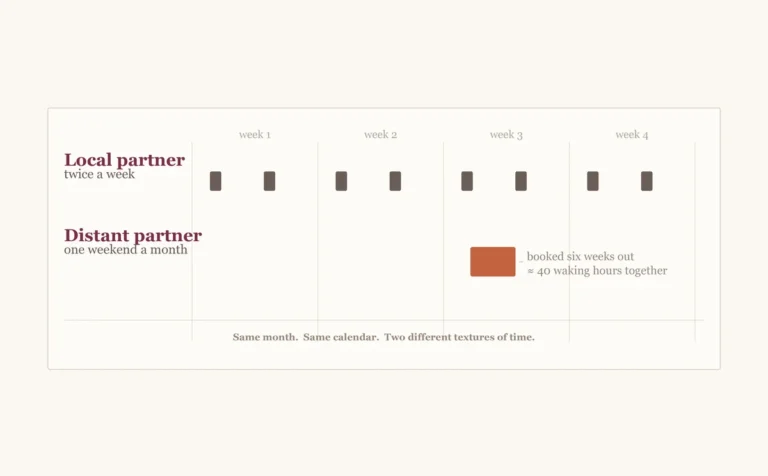
Polyamory multiplies relationships, and each one needs calendar space, which is why dating while polyamorous is partly a scheduling discipline. A new connection that gets your leftover hours will feel exactly like leftover hours, and it will not last.
Be honest about capacity before you start, not after. Two partners and a demanding job is a different offer from two partners and open evenings, and the difference belongs in your profile. Promising time you do not have is a slow way of breaking an agreement you never explicitly made.
Put recurring things on the calendar instead of negotiating them weekly. A standing Tuesday is worth more than three spontaneous evenings a month, because it can be planned around and because it stops being re-earned each time. Then protect it. Rescheduling a standing date to accommodate a newer connection tells your established partner precisely where they rank.
Scheduling is also where jealousy surfaces first, long before anyone says the word. A canceled evening reads as a verdict even when it was only a work crisis. Our guide to tools for jealousy in polyamory covers what to do with that feeling once you notice it.
When Dating While Polyamorous Gets Hard
Some weeks every conversation fizzles and every match feels shallow. Polyamorous dating asks for more emotional labor than monogamous dating, and it asks for it up front, before any reward exists to justify it. That arithmetic is real, and it is not a sign you are doing it wrong.
What helps is remembering what the effort buys. You are choosing connections on purpose rather than inheriting a structure and hoping it fits. Every relationship I have that works is one I agreed to in detail, instead of one I drifted into. That is a harder way to build a life and a more honest one, and our guide to starting out covers the version of this that happens before your first date.
So be patient with yourself. The pool is smaller, the conversations are earlier, and the connections that do form tend to be deeper for exactly those reasons. None of that makes a bad week easier. It does make it worth another week.