Hierarchy and Veto in Polyamory: Who Actually Gets a Say
Most arguments about hierarchy and veto are not really arguments about rules. They are arguments about who counts. One person believes the answer to “who gets a say in my relationships” is settled and obvious; the other has just learned that it is not. And everything painful happens in that gap.
Start with definitions, because people use the two words as though they were one idea. Hierarchy is an order of priority between relationships. Veto is a power: the standing to require another person to end, pause, or narrow a relationship with someone else. So a couple can live inside the first without ever touching the second, and that difference carries most of what follows.
Here is the short version. Hierarchy is often honest. Yet veto is rarely kind, and it usually fails at the exact thing it was built to protect. And rank does not vanish because a group declares itself egalitarian, so pretending otherwise does its own quieter damage.
The Two Words People Confuse
A hierarchy says that one relationship carries more weight in my decisions than another. Sometimes a lease explains it. Sometimes a child does, or ten years, or a legal marriage that neither person can dissolve on a Tuesday afternoon. Still, naming that out loud betrays nobody. In fact, it makes a fact legible, and legible facts are easier to negotiate than invisible ones.
Veto is a different object. It says that I hold the standing to end your relationship. The decision is not mine to advise on; it is mine to make. After all, handing someone that authority is not a statement about priority. It transfers sovereignty over a third person who never agreed to the arrangement.
And watch how often people bundle the two. A couple writes a list of agreements, adds “and if I ever feel unsafe, you end it,” and believes they have described their priorities. What they built is a switch that somebody outside the household can feel, and that nobody outside the household was consulted about.
So the first useful move is simply to separate them in your own head. Ask which of your agreements states a priority, and which one hands somebody the power to end a relationship. The answers are rarely the same list, and the second list is usually shorter than the couple imagined when they wrote it in a hopeful mood. Most of the hierarchy and veto trouble people bring to a therapist starts right there, in a hope that never got written down plainly.
Descriptive Hierarchy and Veto Are Different Animals
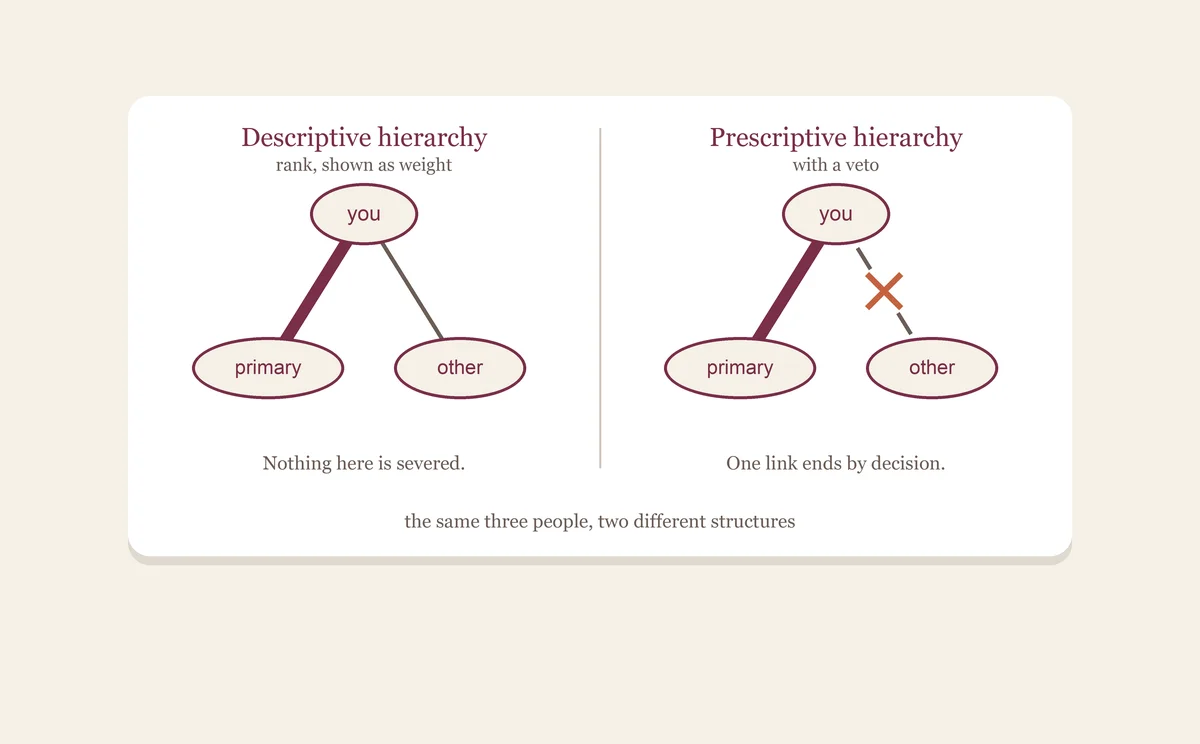
Researchers who study consensual non-monogamy now split hierarchy into two kinds, and the distinction is worth memorizing. Descriptive hierarchy names what is already true. This partner and I share a lease, an account, and a school run, and that shapes how we spend a Tuesday. Prescriptive hierarchy goes further and uses rank to decide in advance what a less central relationship may become.
What Rank Actually Decides
Descriptive hierarchy answers a scheduling question. By contrast, prescriptive hierarchy answers a permission question. Only the second needs enforcement, which is why nearly every hierarchy and veto clause you will find belongs to the second kind.
And enforcement is where the trouble starts. A permission system needs a gatekeeper, and the gatekeeper is always the person in the middle.
Why Hierarchy and Veto Agreements Break
The failure is not a moral failure. Instead, it is structural, and it repeats in the same order every time.
The Hinge Always Loses
Suppose your partner comes home and says the words the agreement promised: stop seeing her. You cannot keep both commitments now. Ending the outside relationship breaks a promise made to a person who did nothing wrong. Meanwhile refusing breaks the one made at home. There is no third door, and no amount of good communication opens one.
People write these clauses imagining a calm conversation. In practice the clause arrives during a bad week, at eleven at night, from someone in pain. Then your partner asks you to choose between two loves with no time to think. That is exactly the condition under which nobody chooses well.
The Person Outside the Room
A veto is an agreement made by two people about a third who is not present. That third person may have been dating your partner for a year. They may have met the children. Yet they hold no vote, get no notice, and have no appeal, so they will experience the outcome as a breakup nobody let them negotiate.
This is the part that makes the practice hard to defend once you look at it directly. Whatever the couple intends, the structure treats another adult as a removable feature of the household’s emotional weather. Call it protective, call it temporary, and it still lands on that person as a decision taken above their head.
Moreover, the mechanism will look familiar to anyone who has read about couples privilege in relationships that begin as a couple’s project. There, a third person gets a welcome for as long as they stay convenient.
The Research on Hierarchy and Veto Is Not Kind
Admittedly the evidence here is thinner than the argument, so read it as a signal rather than a verdict. Still, the signal points one way.
One large comparison of hierarchical and non-hierarchical polyamory, across two samples, found that people in hierarchical arrangements reported lower overall relationship satisfaction and lower attachment security. And the gap was sharpest for people in the secondary and tertiary positions. Primary partners looked much like everyone in the non-hierarchical group, so the structure distributes its costs very unevenly. The study in full also offers a caveat worth keeping: differences that arise organically, rather than by design, sit alongside more similar attachment security across partners. Priority that grows is easier to live inside than priority that somebody handed out in advance.
Also, a 2025 interview study of fifty-one people, spanning strong hierarchy at one end and active rejection at the other, found something both ends agreed on. In practice some amount of prioritizing is inevitable. Priorities are also never immune to change. The paper records participants who described holding, or wanting, the ability to veto a partner’s other relationships, so this is not a fringe arrangement nobody actually uses.
What the study cannot tell you is whether the arrangement works for the people inside it. Interview studies record intentions and beliefs rather than outcomes, and no one has run the trial that would settle the question.
What to Build Instead of Hierarchy and Veto
Most couples reaching for a veto are trying to solve a real problem. They are frightened, and they want a guarantee. The guarantee is the part that has to go. Consequently the real work is figuring out what the guarantee was standing in for. The problem underneath it is usually one of three things, and each has a better answer than a switch.
Replace Hierarchy and Veto With Named Constraints
A constraint is a fact you are willing to state in advance. I need the shared calendar to stay honest. Additionally I need to hear about a weekend away before somebody books it. And I need two nights a week that are ours, which I will not trade away in the middle of another person’s crisis.
Constraints describe what you need. Vetoes describe what someone else may not have. The first invites a conversation about logistics. The second invites a fight about worth, and worth is what people will fight hardest over.
Constraints also survive contact with reality, because one can be met in several ways. Meanwhile a veto has exactly one outcome and no imagination. Where a relationship genuinely has to change shape, there are better tools than a demolition order, and stepping a relationship down on purpose is one of them.
Give a Full Answer, Not a Yes or No
When a partner brings discomfort, the useful move is to say what the discomfort is about. I feel like I am on a shelf. I hear about her only after the fact. And I am scared you will stop wanting the life we built. Each of those is something a person can work on.
“Stop seeing her” is not work. Instead it is an ending, and endings do not resolve the fear that produced them. The scripts for hard conversations on this site follow the same shape. Name the feeling, name the request, and leave room for the other person to move.
When Rank Is Real and Worth Naming
So none of this means rank is a lie. Some hierarchies are load-bearing and honest, and refusing to say so makes life harder for everyone. A couple with a shared mortgage, a child in school, and in-laws they visit at Christmas has real constraints. And a new partner who cannot get a Saturday in June should hear that early rather than discover it in August.
Here is the test that separates the two uses. Descriptive hierarchy changes the logistics of a relationship. Prescriptive hierarchy changes the permissions. You can say “I am not free on Wednesdays” without also saying “you may not become important to me.” The first is usually true. The second is a claim nobody has standing to make on another adult’s behalf, and it is where hierarchy and veto stop being the same conversation.
Practical honesty also means being specific about what a new partner can expect. Time is the usual fault line, and living as the partner who is not primary works best when the limits arrive as scarcity rather than as judgment.
The Conversation to Have Before You Need It
These agreements get written in the abstract, when nobody is upset, and then invoked in the concrete, when everybody is. That mismatch is the whole problem, so move the conversation to a calm afternoon and make it specific. A hierarchy and veto system written in a hopeful week is the one most likely to be invoked in a desperate one, which is exactly backwards from how it needs to work.
Instead, ask three questions out loud. What do we do when a relationship frightens one of us? Who is allowed in the room for that conversation? And what happens to the person we are talking about while we sort it out?
Then write down the answer to the third one, because it is the one nobody plans for. If the plan is “they wait while we work it out,” say that plainly and notice how it sounds.
A working agreement usually looks plain. At first it sets a pause rather than an ending. Next it promises a real conversation within a week. After that it gives the person outside the household a number to call and a name to reach. Above all, it hands the job to boundaries instead of rules, which is the distinction worth learning before any of the others.
Meanwhile the agreement also accepts that discomfort is not an emergency. Much of what escalates into a veto would have settled with a night’s sleep and a few of the tools people use for jealousy, if anyone had let it.
What Actually Gets Better
Drop the veto and the first thing you notice is how much less often you need one. Fear that has somewhere to go stops arriving as a demand. Couples who remove the switch tend to find it was doing almost no protective work and a great deal of damage. Their partner also grew more careful, not less, without it.
Hierarchy will still show up, and it should. So say where the time goes and what the obligations are. But do not dress a permission system as a preference. The honest version takes longer to say, and it is far easier to live with. And the person who is not in the room deserves to hear the honest version. That is the whole argument, really: hierarchy and veto are two different promises, and only one of them is yours to make.