Unicorn Hunting and Couples Privilege: What Goes Wrong

Unicorn hunting is the polyamory community’s most reliable argument, and the reason is not that couples are villains. A couple who go looking for one bisexual woman to date them both are usually running on assumptions they have never had to examine. From inside the search it feels like generosity, since they are offering love and a home and a place in something good. From the other side of the table it looks like a job interview for a role somebody wrote before the applicant arrived.
This piece is for both sides of that table. If you are half of a couple wondering why your messages go unanswered, the pattern has causes, and you can name them. If you are the person couples keep approaching, you will recognize most of what follows. Having language for it makes the whole thing easier to decline.
Here is the short version. The pattern fails because it asks one person to join a structure that two other people designed, and it grants her no standing to change it. No better search will solve that. What has to change is the starting shape.
What Unicorn Hunting Actually Describes
The word comes from the older sense of a unicorn as something rare and probably imaginary. In polyamory it names a specific person: a bisexual or queer woman willing to date both halves of an existing couple. She dates them on roughly equal terms, and usually without other partners of her own. A couple searching for her are doing unicorn hunting.
Three requirements sit inside that description, and each one does separate damage. She must want both of them. She must want them as a package rather than as two separate people. And she must accept that the existing relationship keeps its priority over anything she builds with either of them.
Remove any one of those and you no longer have the pattern. Two people who each happen to be dating the same woman, without the package deal and without the ranking, are just three people dating. That arrangement has its own difficulties and none of this article’s specific problems.
The rarity is real, and it is structural rather than mysterious. Bisexual women are a small share of the dating pool. Couples looking for one are numerous, and their ads are nearly identical. The offer also requires enthusiasm for two distinct people simultaneously, at the same pace. Arithmetic alone would make the search slow. The terms are what make it fail.

Why Unicorn Hunting Got Its Reputation
The reputation is not snobbery, and it did not arrive from nowhere. Community pushback grew because enough people had been on the receiving end to compare notes. The same story kept arriving in the same order.
A woman joins a couple. The welcome is warm and the rules turn out to be more binding than the welcome suggested. She raises a concern, and the conversation shifts to whether she is being difficult. She leaves. The couple conclude that women are unreliable and that the search must continue.
Researchers now document that cycle rather than repeating it as anecdote. A 2022 study of posts in the polyamory subreddit traced how people in these arrangements negotiate an identity the community treats as suspect. The phrase in its title, about enjoying being a second-class citizen, comes from the posters themselves. Alongside the research sits a long-running open letter to couples who have earned the label. It walks through the same failure point by point, and it does so without contempt for the couple.
What Couples Privilege Looks Like Day to Day
Couple privilege means the advantages a pre-existing pair receives without asking for them. Some of it is social: the plus-one on the invitation, the automatic assumption that you are each other’s emergency contact. A restaurant seats two without a second thought, and nobody finds that strange. Some of it is legal and financial, and that part is enormous, because the machinery of marriage and next of kin does not stretch to accommodate three.
None of that is a personal failing. The difficulty starts when the people holding those advantages stop seeing them. Those advantages then enter the terms of a relationship that has not begun.
The Defaults Nobody Chose
Consider what a couple usually has arranged before anyone new appears. They share a home and a bed and a calendar. They have years of shorthand, a settled argument about whose family gets the holiday, and a working knowledge of each other’s bad weeks.
A newcomer meets all of it at once, already fully formed, and the couple asks her to find a place inside it without disturbing anything. That is not the same as joining a relationship. That is joining an institution with two founders and no procedure for admitting members.
When Uncommon Courtesy Becomes a Rule
The next stage is where privilege turns into something you can point at. Affection hardens into policy. She cannot have sex with either of them alone. The couple reserve particular acts, particular pet names, particular hotels for themselves. Their relationship holds a veto over hers, and a bad week between the two of them becomes a pause on everything else.
Read that list again and notice who drafted it. Two people wrote every clause about a third they had not yet met. Each clause sounds defensible on its own, so nobody examines the whole set as a set. Nobody in the room is placed to notice the accumulation.
Why Unicorn Hunting Usually Fails
The Box Built Before Anyone Arrives
Two people sit down and negotiate the shape of a future relationship with a person they have not met. They settle the frequency of dates, the sexual rules, the level of disclosure, the holidays, the sleeping arrangements. Then they go looking for someone who fits the result.
Every one of those decisions is a wall. Most of them are no longer negotiable by the time she arrives, because the couple agreed them as a condition of her arrival rather than offering them as subjects for discussion. She is not choosing a relationship. She is accepting a tenancy, and the terms were fixed before anyone knew her name.
This is also where the difference between a boundary and a rule matters most. A boundary describes what you will do. A rule describes what someone else may do, and rules written for a stranger are the raw material of every story in the next section.
The Couple as a Single Decision-Maker
Then comes the structural problem, which no amount of kindness fixes. In this arrangement, two people hold a permanent majority. Two of them can settle any disagreement by conferring. The pair always have a private conversation she does not join and cannot appeal.
Healthy relationships do not operate that way. Two people in a couple do not resolve their disagreements by consulting a third party who holds binding authority. Asking a new partner to accept a structure your own relationship could not survive is a strange offer. The person receiving it generally notices before you do.
What Couples Doing Unicorn Hunting Are Really Looking For
Almost nobody sets out to treat a person as an appliance. So what is the actual wish underneath the search? Couples tend to bundle three different wants into one advertisement, and separating them is most of the work.
Company, Novelty, or a Witness
The first want is simple company, since a third person makes a household feel less like a closed loop. The second is novelty, which is honest and entirely reasonable. The third is subtler. Sometimes what a couple wants is someone to watch them being a couple, and to confirm that what they have built is desirable.
Only the first two are things you can ask of a person. The third quietly recruits her as an audience. An audience who must also sleep with the performers has very little room to complain about the show.
What the Search Is Hiding
Here is the uncomfortable part. Couples frequently begin this search during a rough patch, on the theory that a shared project will bring them closer together. The project works for a while, because planning is intimacy of a kind. Then the third person becomes the project, and later becomes the explanation when it falls apart.
If a relationship needs repair, adding a participant will not repair it. Adding a participant gives the fault line a witness and somewhere else to travel. Meanwhile the jealousy that prompted the search sits untouched. That is why the tools for working through jealousy are worth more to a struggling couple than any dating profile.
What the Research Says About Hierarchy
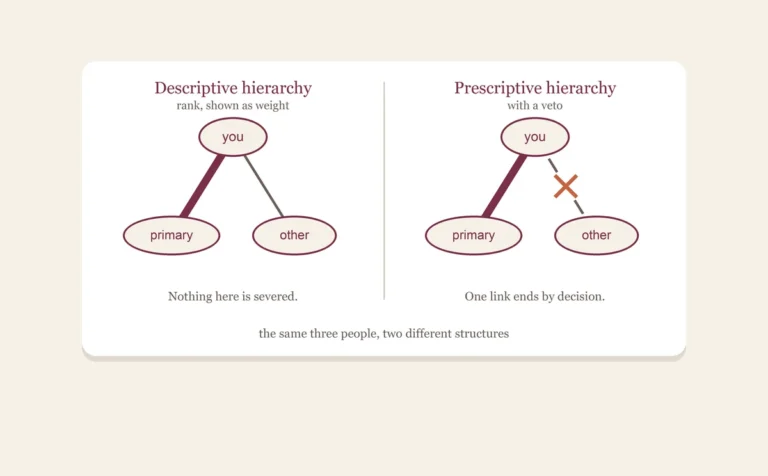
The evidence is not comfortable for arrangements that rank people in advance. One study of 585 people across two samples compared those in hierarchical polyamory with those in non-hierarchical configurations. In the hierarchical group, a primary partner ranks above the others.
People in hierarchical arrangements reported lower relationship satisfaction and lower attachment security overall. The gap was sharpest for secondary and tertiary partners, and it was most reliable in relationships of five years or less.
Read that carefully, because the finding is narrower than it is often made to sound. The research does not say hierarchy is wicked. It says that ranking people produces measurably worse experience for those near the bottom. The people at the top are the last to feel it. Unicorn hunting is ranking at its most extreme: a permanent first tier, written in advance. The newest person takes the floor by definition.
How Unicorn Hunting Changes Without the Harm
Some couples genuinely want a shared connection, and that wish deserves better than dismissal. What has to change is the shape of the search rather than its existence.
Date as Individuals, Not as a Unit
This is the largest change and the one that costs the most. Two people each date the new person separately, at their own pace, under their own agreements. Sometimes both connections develop. Often one does and the other does not, and that outcome must be survivable rather than treated as a failed experiment.
This is slower and messier. It is also the only version where she gets to be a person rather than a vacancy. And it protects the couple, since a connection that grew honestly can survive one half of it cooling, while a package deal cannot.
Give a New Person Standing on Day One
Standing means she can refuse a rule, and the couple hear the refusal. Concretely, that means no veto over her other relationships and no obligation to be sexual with both of you. It means no requirement to keep the arrangement secret from her own friends. It also means a real answer when she asks what happens if she and one of you fall out.
Then write it down together. A promise made warmly in week two is worth less than a document all three of you agreed to and can revise. Vagueness is what turns an open arrangement into a slow grievance.
If You Are the Person Being Approached
You do not owe anyone a hearing, and you are allowed to end the conversation early and without explanation. Still, four questions will sort a couple who have thought about this from one that has not. The answers arrive faster than any profile will tell you.
Start with this one: what happens if you and one of them lose interest while the other connection is thriving? Then ask who decides the rules and whether you get a vote. Ask whether they are out to anyone, and what you would be introduced as. Finally, ask what they would do if you fell in love with someone else.
The answer to that last one is the one to listen for. A couple who expect you to stay exclusive while they remain each other’s primary have handed you the entire pattern in one sentence. They have usually done it without noticing.
On the practical side, declining costs you nothing. A couple who treat rejection as evidence about women have told you everything about how they handle a disagreement.
Unicorn Hunting Is Not the Only Option
There is a version of this that works, and it looks less like a hunt than like three people who each chose the others. It is slower to find, and it has no clear starting point. It requires the couple to accept that the relationship they are opening will change, instead of demanding that the new person guarantee it will not.
When you are starting from nothing, the practical guide to starting polyamory covers the community side of meeting people. Should the vocabulary here be unfamiliar, what a metamour is explains the role a third person usually ends up occupying. If you are still deciding whether any of this is for you, start with the plain-language answer to what polyamory means rather than a dating app.
What none of it can do is turn a person into a solution. The white unicorn in the tapestry is not free. It rests inside a fence somebody built around it, wearing a collar somebody else chose. It makes a beautiful picture and a very poor model for a relationship.
If you are reading this because someone called you a unicorn hunter, treat that as useful information rather than an insult. The pattern is visible from the outside, which means you can change it from the inside. Start by asking the person you have not met yet what she would actually want. Mean the question when you ask it.